


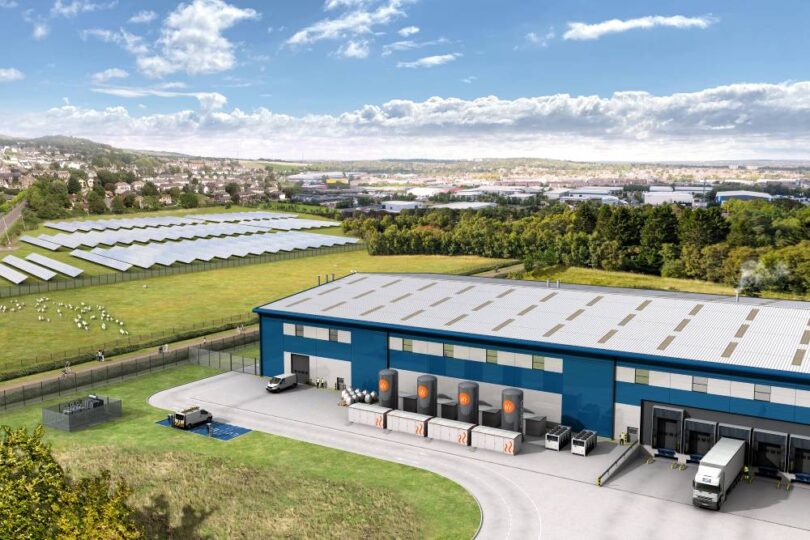
Caldera, a British manufacturer of electric thermal storage systems, has brought a commercial-scale industrial heat battery into operation at its Hampshire facility. Lord Whitehead CBE, Minister of State for Energy Security and Net Zero, switched on the system, which the company describes as a UK first at this scale.
How the heat battery works
The system uses a solid core made from aluminium and iron pellets, enclosed within a vacuum insulation cover to retain heat. It is charged with electricity — including cheaper off-peak or renewable power — and stores that energy as heat until an industrial site needs it. Caldera says the unit can store up to 5MWh of heat and deliver steam in excess of 200°C, equivalent to around 16 bar.
Designed as a plug-and-play unit that can sit alongside or replace existing boilers, the system is aimed at manufacturers in sectors such as food, drink, pharmaceuticals and chemicals. The company says it is particularly suited to sites with “peaky” steam demand — short bursts of high-temperature heat that can make conventional electrification difficult, slow or expensive.
Decarbonising industrial heat
Industrial heat is one of the harder parts of the economy to decarbonise. According to UK government figures cited by the company, industry accounted for 16% of UK greenhouse gas emissions in 2018, making it the third-largest emitting sector, and most industrial heat is still produced by burning fossil fuels. Caldera’s heat battery is part of a wider push to store energy for when it is needed, from grid-scale battery storage to long-duration energy storage projects now being built across Europe.
“Heat is vital to so many industrial processes, from brewing beer to pet foods and pharmaceutical products — but this heat is still typically generated from fossil fuels,” said Lord Whitehead. “By using low carbon electricity to create and store heat, then releasing it when industry needs it, this British technological innovation provides a practical alternative to fossil fuels.”
James Macnaghten, chief executive of Caldera, said steam remained “one of the hardest parts of the economy to decarbonise,” adding that for many manufacturers the challenge was not constant heat demand but “short, sharp peaks of usage that force them to keep relying on fossil-fuel boilers.”
Investment and scale-up
Caldera, founded in 2017, has secured £10 million of investment from German industrial group GEA, one of the world’s largest suppliers of systems to the food, beverage and pharmaceutical industries. The company says it is seeing interest from sectors across the UK, Europe and beyond, and aims to scale the technology internationally.
Frequently asked questions
What is Caldera’s heat battery?
A commercial-scale electric thermal storage system that converts electricity into stored heat and delivers it as high-temperature steam for industrial use.
How does it work?
A solid core of aluminium and iron pellets in a vacuum-insulated cover is charged with electricity, often cheaper off-peak or renewable power, and discharges heat on demand — up to 5MWh, delivering steam above 200°C.
What is it used for?
Helping manufacturers in sectors such as food, drink, pharmaceuticals and chemicals reduce their reliance on fossil-fuelled boilers, especially where steam demand is “peaky”.
Why does industrial heat matter for net zero?
Industry was the UK’s third-largest emitting sector in 2018 at 16% of emissions, and most industrial heat still comes from fossil fuels, so decarbonising heat is central to meeting climate targets.