


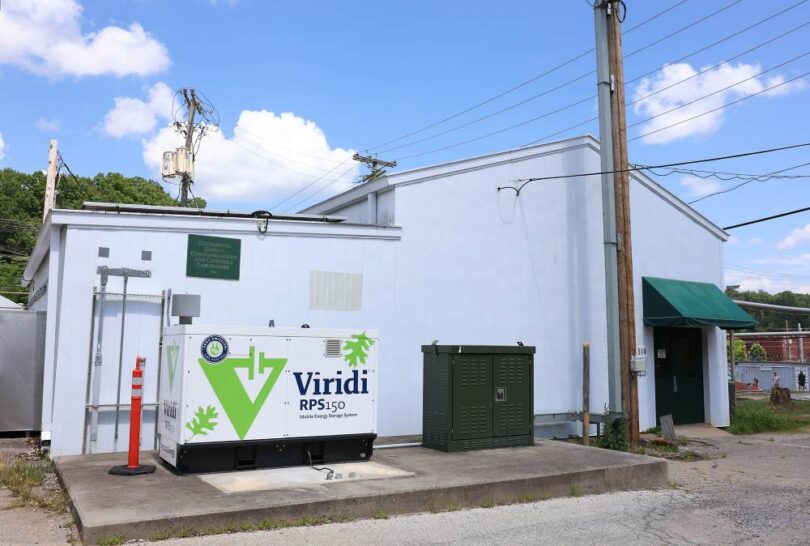
Viridi has partnered with Oak Ridge National Laboratory to support research into next-generation grid technologies designed to improve resilience and reliability.
As part of the partnership, Viridi’s RPS 150 battery energy storage system has been installed at ORNL’s Grid Research Innovation and Development Center, known as GRID-C.
The system is being used as part of a U.S. Department of Energy resource integration and evaluation project focused on how clusters of grid resources can be controlled to meet utility needs.
From lab testing to live-grid validation
The research began with ORNL developing a system to control grouped grid resources. Initial testing took place in an indoor laboratory using emulated energy sources and battery storage.
ORNL then moved to live-grid testing with real equipment to assess how the control system performs under more complex conditions, including physical equipment interactions and real-world battery charging dynamics.
Viridi’s RPS 150 was installed at GRID-C’s Power Distribution Field Test Site, where ORNL integrated its converter system with the battery to validate the technology.
“This project bridges an important gap by integrating real electrical equipment to understand realistic performance challenges,” said Dr Madhu Sudhan Chinthavali, electrical systems integration programme manager at Oak Ridge National Laboratory.
“Viridi’s battery integrated seamlessly with our management system, and its engineering team supported our researchers throughout testing and integration, making them a valuable partner.”
Energy storage and grid modernisation
Battery energy storage systems are becoming increasingly important as utilities work to modernise ageing grid infrastructure, integrate distributed energy resources and improve resilience against disruption.
ORNL’s GRID-C facility supports research in grid systems integration, modelling, energy storage, analytics and security. The centre includes laboratory and field-test infrastructure designed to help move new grid technologies from research into utility-scale applications.
For Viridi, the partnership represents a validation of its fail-safe lithium-ion battery platform in a national laboratory environment.
“Being selected by Oak Ridge National Laboratory to support the project is a milestone for Viridi and a validation of what we have built,” said Jon M. Williams, CEO of Viridi.
“We built Viridi’s fail-safe BESS to perform in exactly these kinds of environments, and we are proud to be partnering with ORNL to advance the grid modernisation solutions that utilities across the country need.”
Testing has concluded, with ORNL expected to present project findings in the coming months. Viridi said the collaboration marks the start of an ongoing research relationship, with additional joint projects planned.
FAQs
What is Viridi’s RPS 150?
The RPS 150 is Viridi’s mobile battery energy storage system, designed for commercial, industrial and infrastructure applications.
What is ORNL’s GRID-C?
GRID-C is Oak Ridge National Laboratory’s Grid Research Innovation and Development Center, a facility for testing grid systems, power electronics, energy storage, controls, modelling and cybersecurity technologies.
Why is live-grid testing important?
Live-grid testing allows researchers to validate control technologies using real electrical equipment and operational conditions, rather than relying only on laboratory emulation.
How do batteries support grid resilience?
Battery energy storage systems can help balance supply and demand, support distributed energy resources, improve flexibility and provide backup or stabilisation services during disruptions.
(Photo credit: Amy Smotherman-Burgess/ORNL, U.S. Department of Energy).