

Artificial intelligence infrastructure developer GIGATONS has announced a strategic global partnership with Schneider Electric to accelerate the deployment of gigawatt-scale AI data centres powered by integrated renewable energy systems.
The collaboration combines GIGATONS’ proprietary GIGABLOCK™ energy platform with Schneider Electric’s expertise in critical power, automation and digital infrastructure, with the aim of delivering AI compute capacity significantly faster than conventional grid-connected developments.
According to the companies, the partnership addresses two of the biggest constraints facing AI expansion worldwide: access to electricity and access to water. Rather than relying on lengthy utility grid connection processes, GIGATONS is developing self-powered AI campuses that integrate renewable energy generation, battery storage, water infrastructure and computing facilities into a single platform.
The companies say this approach enables deployment within approximately 12 months, compared with grid connection times that can often exceed five years in many markets.
Nearly 1 GW development pipeline
GIGATONS is advancing an initial development pipeline approaching 1 GW of AI compute capacity, with flagship developments planned in Abu Dhabi and Australia.
The first phase is expected to deliver around 100 MW of AI compute capacity in each location before expanding significantly over the coming years.
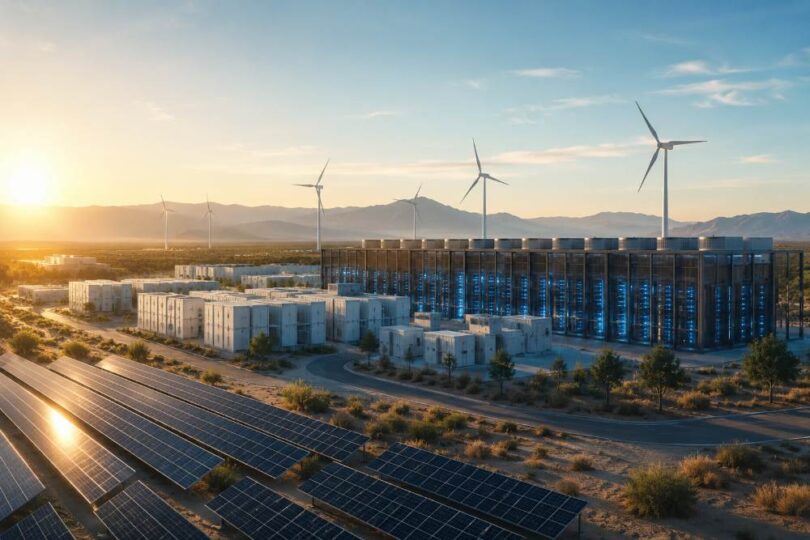
The integrated facilities, known as GIGACENTERS™, combine renewable energy generation, energy storage, water generation and AI computing infrastructure within a single campus designed to operate independently of conventional utility networks.
Toddington Harper, Founder and CEO of GIGATONS, said:
“The future of artificial intelligence is not being constrained by chips, but by power. GIGATONS was created to solve that challenge by developing a completely new model for AI infrastructure – one that integrates solar power, water and compute into a single platform that can be deployed rapidly and scaled globally.
“Our partnership with Schneider Electric brings together two organisations committed to rethinking what is possible, creating a new blueprint for delivering AI infrastructure at gigawatt scale.”
Integrated infrastructure approach
Unlike traditional data centres that depend on utility grid expansion before construction can begin, the GIGATONS model combines energy infrastructure and computing capacity from the outset.
Each GIGACENTER integrates:
- Renewable solar generation
- Battery energy storage
- Microgrid infrastructure
- Water generation systems
- AI data centre facilities
The companies say this integrated approach is intended to improve deployment speed while increasing operational resilience through reduced reliance on constrained electricity networks.
Focus on reliability and resilience
The partnership will also see Schneider Electric support the design and deployment of highly efficient AI infrastructure using its expertise in power management, cooling, automation and digital infrastructure.
The companies said GIGACENTERS are being engineered to achieve up to 99.999% availability, combining Schneider Electric’s critical infrastructure technologies with GIGATONS’ renewable energy platform.
Amel Chadli, President, Gulf Cluster at Schneider Electric, said:
“Abu Dhabi is becoming one of the most important places in the world to build the infrastructure behind artificial intelligence, and that progress depends on getting energy right.
“Through this partnership, Schneider Electric brings its role as an energy technology partner, integrating power, cooling, software and services from grid to chip and chip to chiller, to help GIGATONS design AI campuses that are efficient, resilient and ready to scale.”
Abu Dhabi selected for first deployment
The companies said Abu Dhabi’s renewable energy resources and growing investment in artificial intelligence make it an ideal location for the first phase of deployment.
The partnership aims to establish a repeatable model for large-scale AI infrastructure that can be replicated internationally as demand for AI computing continues to increase.
AI infrastructure drives demand for integrated energy systems
Rapid growth in artificial intelligence is creating unprecedented demand for high-capacity data centres, placing increasing pressure on electricity networks and water resources.
Many proposed AI facilities face lengthy delays because of limited grid capacity and extended utility connection timelines. As a result, developers are increasingly exploring alternative approaches that combine on-site renewable generation, energy storage and advanced power management technologies.
Integrated infrastructure platforms such as the GIGATONS model seek to address these challenges by designing energy, water and computing systems together from the earliest project stages. By reducing dependence on conventional grid expansion, developers aim to accelerate deployment while improving resilience and supporting sustainability objectives.
The partnership reflects a wider trend across the digital infrastructure sector towards self-powered campuses capable of supporting energy-intensive AI workloads while reducing pressure on existing electricity networks.
Frequently Asked Questions
What have GIGATONS and Schneider Electric announced?
The companies have formed a strategic global partnership to develop self-powered AI data centres that integrate renewable energy, battery storage, water infrastructure and AI computing.
Where will the first projects be built?
Initial flagship developments are planned in Abu Dhabi, UAE, and Australia.
How much AI capacity is planned?
The development pipeline currently approaches 1 GW of AI compute capacity, with the first phase targeting approximately 100 MW in each market.
What is a GIGACENTER?
A GIGACENTER is GIGATONS’ integrated AI campus that combines renewable power generation, battery storage, water infrastructure and AI data centre facilities within a single development.
Why is this different from conventional data centres?
The facilities are designed to generate their own renewable power using integrated microgrids, reducing reliance on utility grid connections that can delay projects for several years.