

Chemical recycling under PPWR could gain momentum as new EU packaging rules tighten recyclability and recycled-content requirements, according to IDTechEx analysis of the regulatory and technology landscape.
The EU Packaging and Packaging Waste Regulation (PPWR) began applying across the bloc on 12 August 2026, replacing the previous Packaging and Packaging Waste Directive with a harmonised framework covering the packaging lifecycle.
The regulation introduces measures designed to reduce waste, increase recyclability and expand the use of recycled materials in plastic packaging.
Analysis from IDTechEx suggests these requirements could become a significant driver for chemical recycling and other advanced recycling technologies, particularly for packaging that is difficult to process through conventional mechanical recycling.
Chemical recycling under PPWR gains attention
The PPWR requires Member States to reduce packaging waste generated per capita by at least 5% by 2030, 10% by 2035 and 15% by 2040 compared with 2018 levels.
The regulation also introduces recyclability requirements for packaging and minimum recycled-content targets for plastic packaging.
The European Commission says that from 2030, packaging will increasingly be assessed against harmonised recyclability criteria, while recycled-content requirements will apply to a range of plastic packaging formats.
These measures form part of the EU’s wider effort to reduce reliance on virgin materials and strengthen markets for secondary raw materials.
Extended producer responsibility puts pressure on packaging design
Extended producer responsibility (EPR) forms another part of the changing regulatory landscape.
Under EPR systems, producers contribute towards the costs associated with collecting and managing packaging waste, creating an economic incentive to reduce waste and improve packaging design.
IDTechEx argues that higher costs associated with difficult-to-manage packaging could encourage companies to develop formats that are easier to reuse or recycle.
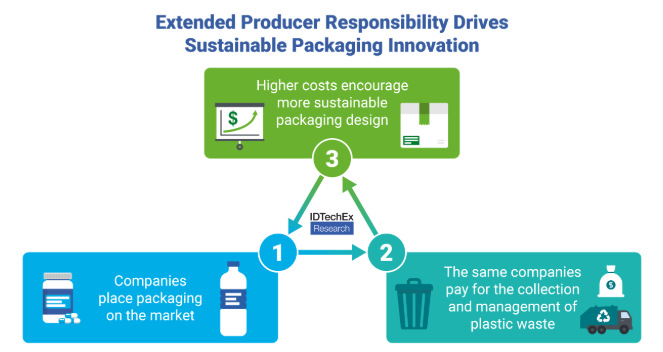
Extended producer responsibility can create financial incentives for more sustainable packaging design. Graphic: IDTechEx.
The PPWR also aims to replace fragmented national packaging requirements with a more consistent framework across the EU’s internal market.
Advanced recycling targets difficult plastic waste streams
Mechanical recycling remains central to plastics circularity, but some packaging presents significant technical challenges.
Multilayer packaging and mixed plastic streams can combine polymers, metals, paper, adhesives and other materials that are difficult to separate while maintaining the quality required for secondary applications.
IDTechEx identifies several advanced approaches that could complement mechanical recycling.
Depolymerisation can break suitable polymers into constituent monomers, while dissolution separates and recovers polymers without breaking their chemical bonds.
Other chemical recycling technologies include pyrolysis, hydrothermal liquefaction and gasification, which can convert plastic-containing feedstocks into hydrocarbon liquids, gases or chemical building blocks.
However, IDTechEx also notes significant challenges around economics, scalability and environmental performance. Recent plant closures and project failures demonstrate that announced capacity does not necessarily translate into commercially viable recycling infrastructure.
Recyclability rules could change packaging choices
The PPWR introduces a graded system for assessing packaging recyclability.
From 2030, packaging will need to meet applicable design-for-recycling requirements, with recyclability expressed through performance grades.
Further requirements concerning whether packaging is recycled at scale are scheduled to apply later.
IDTechEx suggests this could increase pressure on companies using complex packaging formats to reconsider materials and design choices.
For applications where mechanical recycling cannot readily produce material of sufficient quality, advanced recycling technologies could provide an additional route for recovering plastics and returning them to production.
Mass balance could support recycled-content reporting
The PPWR also establishes minimum recycled-content targets for plastic packaging, assessed according to regulatory methodologies that are continuing to be developed through EU secondary legislation.
IDTechEx argues that this could strengthen interest in mass-balance approaches for chemical recycling.
Unlike physical segregation, mass balance can allocate recycled feedstock across outputs from an industrial facility where recycled and virgin materials are processed within the same production system.
This is particularly relevant to chemical recycling routes that integrate recycled feedstocks into existing petrochemical infrastructure.
As recycled-content requirements increase towards 2040, IDTechEx expects demand for technologies capable of producing material suitable for higher-value packaging applications to grow.
Chemical recycling market forecast to expand
IDTechEx forecasts that the global chemical recycling and dissolution market will grow at a compound annual growth rate of 25% between 2027 and 2037.
The research company estimates advanced recycling plants could process more than 23 million tonnes of plastic waste annually by 2037.
Its analysis covers pyrolysis, depolymerisation, hydrothermal liquefaction, gasification and dissolution technologies, as well as their environmental performance, economics and commercial development.
IDTechEx stresses that chemical recycling is not a single solution to plastic waste. Different technologies have varying strengths and limitations, while economics, energy consumption, feedstock quality and environmental impacts remain important considerations.
Nevertheless, tighter packaging regulation and demand for recycled materials could increase the role of advanced technologies alongside conventional mechanical recycling.
For more news on circular materials and industrial sustainability, visit Climate Global News’ Manufacturing & Recycling section.
Read more about chemical recycling technologies being investigated for difficult plastic waste streams.
Source: IDTechEx; European Commission