


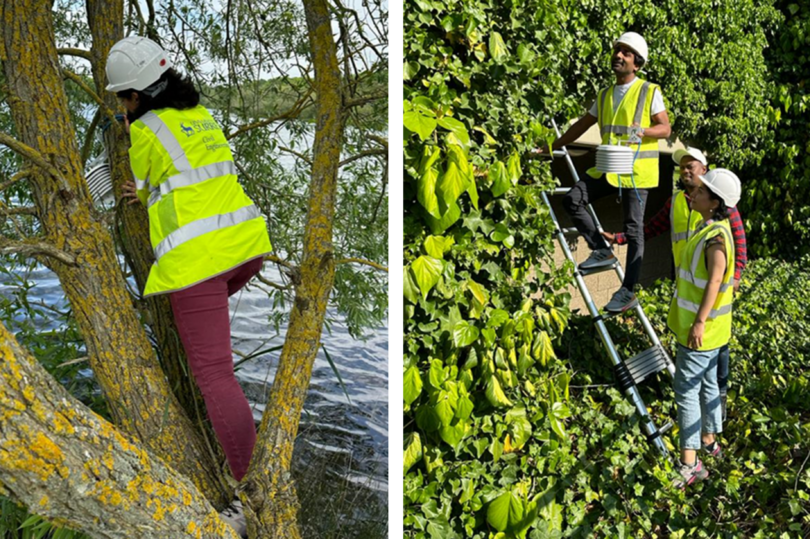
Green and blue spaces could help cities reduce extreme heat, with University of Surrey research finding woodlands, grasslands and lakesides were cooler than built-up areas during summer heat events.
Green and blue spaces such as woodlands, riversides, lakesides and grassland could provide a line of defence for cities facing hotter summers, according to new research from the University of Surrey.
The study, published in Environment International, monitored temperatures across Guildford for three years to examine how different urban environments respond to heat.
Researchers from Surrey’s Global Centre for Clean Air Research compared six types of green and blue infrastructure: woodland, lakeside, grassland, a pocket park, riverside and a green wall.
They then compared those sites with a built-up area between June 2023 and August 2025.
Green and blue spaces reduce urban heat
During peak summer hours, all six green and blue sites were cooler than the built-up location.
The woodland site recorded the greatest difference, at around 2.5°C cooler, followed by grassland at 2.3°C and lakeside at 2.1°C.
Across ten extreme heat events analysed during the study, the woodland site was on average 4.5°C cooler during the daytime than the built-up site.
The researchers said differences frequently exceeded 5°C to 6°C during the most severe heatwaves, while grassland and lakeside areas were around 4°C cooler on average.
The research adds to evidence that nature-based solutions can support climate adaptation in urban areas. The University of Surrey’s Guildford Living Lab uses local monitoring and community partnerships to study urban climate, air quality and green-blue infrastructure.
Woodland site recorded no heatwave periods
The study also compared how often each location experienced heatwave conditions.
In Surrey, heatwave conditions were defined as temperatures reaching at least 28°C for three consecutive days.
Over the three summers, the built-up site experienced 54 heatwave days. Heatwave conditions accounted for 19.6% of summer daytime observations at the built-up site.
By comparison, all six green and blue spaces experienced significantly less extreme heat.
The green wall recorded the highest exposure among the six green-blue sites, at 8.7%, while the woodland area recorded no heatwave periods.
Study used sensors and satellite data
As part of GCARE’s Guildford Living Lab, the research used a network of sensors to record temperature and humidity every minute at seven locations across Guildford over three years.
The team also used satellite data to provide a broader picture of urban temperatures.
Satellite observations showed substantial differences in summer surface temperatures, particularly between built-up, woodland and lakeside areas.
The full paper is titled Microclimatic performance of greening against urban overheating: a multiseasonal analysis using in-situ monitoring and satellite data.
Researchers urge nature-led urban design
Professor Prashant Kumar, Founding Director of GCARE at the University of Surrey and corresponding author of the study, said:
“Summer 2026 has felt like a wake-up call for the impact of increasingly hot summers, and we now have three years of evidence showing the difference nature can make. What was most surprising was the woodland site, where we recorded no heatwave conditions – compared with almost a fifth of summer daytime observations at the built-up location.
“There is no one-size-fits-all solution, but our findings show why trees, green spaces and water should be an important part of how we design towns and cities to cope with a warmer climate.”
While woodland showed some of the largest and most consistent temperature differences, the research team cautioned that each type of green and blue infrastructure was represented by one location.
This means local conditions may have influenced the results. Future studies could examine multiple examples of each type and how their cooling effects extend into surrounding streets and neighbourhoods.
Long-term evidence can inform climate adaptation
Soheila Khalili, postgraduate researcher at GCARE and lead author of the study, said:
“After three years of monitoring these sites through ordinary summer days and intense heatwaves, it was striking to see just how differently they responded to the same conditions. As our summers get hotter, this kind of long-term evidence can help us make better decisions about the green and blue spaces we build into our towns and cities.”
The work was supported through RECLAIM Network Plus, GP4Streets, GreenCities, GREENIN and University Global Partnership Network-funded projects.
For more climate adaptation and resilience coverage, visit CGN’s Climate Change section.
Source: University of Surrey