


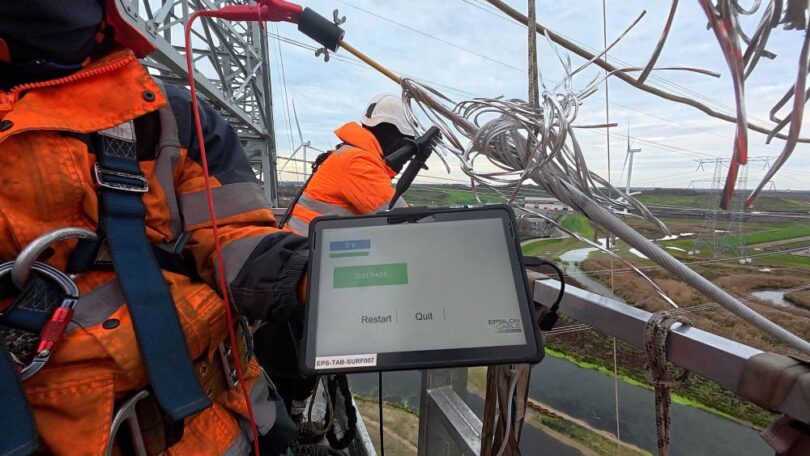
Nexans and Epsilon Composite have validated CORECHECK technology on a TenneT 380 kV transmission line in the Netherlands.
The companies describe the project as the first field validation of the technology on a live transmission network. CORECHECK is designed to verify the structural integrity of composite-core overhead conductors during transport, installation and commissioning.
The deployment supports TenneT’s work to increase grid capacity as electricity demand, renewable generation and electrification place greater pressure on European networks.
CORECHECK technology tested on TenneT network
TenneT is using High Temperature Low Sag conductors, including Nexans’ High Voltage Composite Reinforced Conductor, to upgrade existing overhead lines.
The approach can help increase transmission capacity without requiring extensive new infrastructure. It is part of a wider shift towards reconductoring as grid operators look for faster ways to unlock capacity.
Until now, Nexans said there had been no practical field method to verify that composite cores remained undamaged during transportation, handling and installation.
Composite-core conductors gain quality check
CORECHECK detects internal defects in the composite core using a breakdown voltage test. The method uses the insulating properties of the conductor’s glass fibre outer layer.
The test is designed for use in the field and can typically be completed by one technician in around five minutes per conductor. Nexans said this allows testing to be added without disrupting installation schedules.
Utilities are looking for ways to increase network capacity quickly while maintaining the highest levels of reliability.
Stéphane Morice, OHL sales director, Nexans
By integrating CORECHECK into our HVCRC solution, we are providing customers with a practical way to verify conductor integrity throughout the installation process. This gives utilities and contractors greater confidence that critical transmission infrastructure has been installed correctly and is ready to perform throughout its operational lifetime.
Stéphane Morice, OHL sales director, Nexans
Testing completed in difficult field conditions
During the TenneT project, conductor integrity was checked at key points in the project lifecycle. This included after core manufacture by Epsilon Composite, after conductor stranding by Nexans, on delivery to site and after installation.
The testing was completed in strong winds, dense fog, heavy rain and sub-zero temperatures. Nexans said it also showed compatibility with complex transmission environments where nearby circuits were energised.
Epsilon Composite – a long-standing Nexans partner in advanced overhead conductors – is proud to have successfully developed CORECHECK, an innovative system for monitoring composite core integrity, supporting safer and faster grid modernization. This first successful in-field deployment on Tennet’s grid definitely marks a key milestone for our companies.
Alexandre Lull, managing director, Epsilon Composite
Traceability added to grid installation projects
CORECHECK provides a pass or fail assessment and records operator identification, conductor batch information and measurement results for each test.
This creates a quality record for utilities, engineering contractors and manufacturers. It can also support accountability across complex infrastructure projects where several parties are involved.
The CORECHECK procedure takes approximately five to ten minutes per conductor, so around 15 minutes for each phase. We remained on schedule because the test integrates smoothly into the installation process while providing verification of conductor integrity.
Negar Iswini, overhead line engineer, TenneT
A technical paper on the project and field validation results will be presented at CIGRE Paris Session 2026.
More coverage of electrification and grid technology is available in the Climate Global News Energy section, including recent reporting on a Nexans DC microgrid pilot.
FAQs
What is CORECHECK technology?
CORECHECK is a monitoring technology that checks the integrity of composite cores in overhead power conductors during manufacture, delivery, installation and commissioning.
Where was CORECHECK validated?
CORECHECK was field validated on a 380 kV transmission line operated by TenneT in the Netherlands.
Why do composite-core conductors need testing?
Composite-core conductors can help increase grid capacity, but utilities need confidence that the core has not been damaged during handling, transport or installation.
How long does a CORECHECK test take?
Nexans said the test can typically be completed by one technician in about five minutes per conductor.