


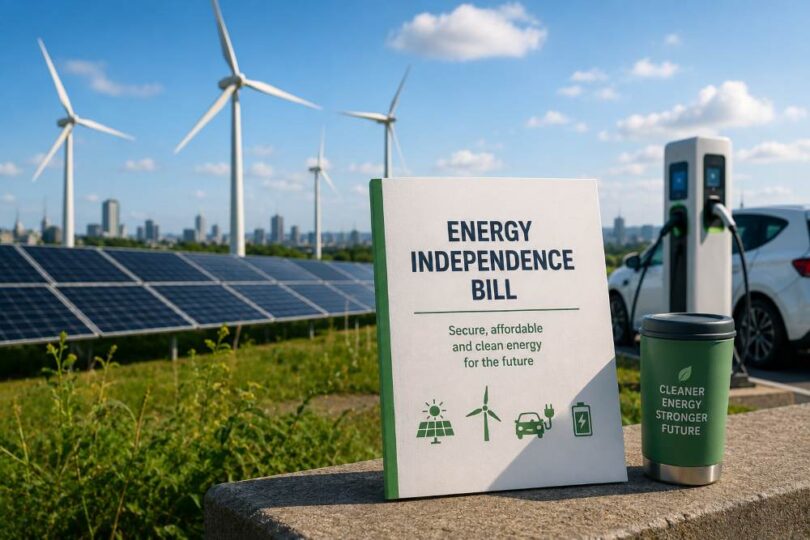
The Energy Independence Bill UK clean power agenda is expected to feature in the King’s Speech this week, setting out new legislation aimed at strengthening energy security, reducing exposure to volatile gas prices and accelerating clean electricity deployment.
The bill is expected to build on Labour’s 2024 manifesto commitment to introduce an Energy Independence Act, designed to establish the framework for the government’s energy and climate policy. The legislation is likely to be closely watched by households, clean energy developers, investors and devolved administrations.
Energy Independence Bill UK clean power plans expected in King’s Speech
Rising energy bills and security of supply remain major political and economic pressures for the government. Energy Secretary Ed Miliband is expected to push forward with measures intended to reduce the UK’s exposure to international fossil fuel markets while supporting the shift towards clean, domestic electricity.
A central part of the expected policy direction is the government’s plan to weaken the link between wholesale gas prices and electricity bills. Under the current market structure, gas-fired power stations often set the marginal price of electricity, meaning spikes in international gas prices can affect household and business bills even when a growing share of electricity is generated by renewables.
The government has said it wants to move some older renewable electricity projects onto long-term fixed-price contracts, bringing them closer to the system used for newer clean power projects. This could help make bills more stable, although analysts have warned that near-term savings may be limited.
Windfall tax rise and fixed-price contracts
The government has already announced plans to increase the Electricity Generator Levy from 45% to 55% from 1 July 2026. The levy applies to some electricity generators that make exceptional revenues when gas prices rise.
Ministers argue the change will encourage older renewable generators to switch voluntarily to fixed-price contracts, reducing the influence of gas prices on electricity costs. The policy is also intended to ensure that a larger share of excess revenues can be used to support households and businesses during periods of high energy prices.
Industry reaction is likely to focus on how the balance is struck between short-term consumer protection and maintaining investor confidence in future clean energy projects.
Planning changes for EV charging and solar
The Energy Independence Bill UK clean power package may also include measures to make it easier to install electric vehicle chargers, particularly for households without driveways.
Planning reforms are also expected to support wider deployment of solar panels for businesses and public-sector sites, helping to accelerate electrification and reduce reliance on fossil fuel generation.
Some areas of energy policy are devolved, so the extent to which the bill applies across Scotland, Wales and Northern Ireland remains an important question. The final legislative detail will determine how far the proposals apply across the UK.
What the Energy Independence Bill could mean for climate policy
The expected legislation reflects a broader shift in climate and energy policy: moving from clean power as an environmental objective to clean power as an energy security strategy.
Supporters of the approach argue that expanding domestic renewable generation, storage and electrification can reduce dependence on volatile international gas markets while cutting emissions. Critics are likely to question the cost of subsidies, levies and market intervention, and whether the reforms will deliver meaningful bill reductions quickly enough.
The bill could become a key test of the government’s ability to connect climate policy with household affordability. If successful, it may help frame clean energy as a route to price stability rather than simply a long-term decarbonisation goal.
For more analysis of clean power and energy policy, visit our Energy coverage.
A defining moment for the UK energy transition
The King’s Speech is expected to come at a politically sensitive moment, with the government seeking to reset its agenda and demonstrate action on bills, energy security and climate commitments.
The final shape of the Energy Independence Bill will determine whether it becomes a technical market reform, a broader clean power acceleration package, or a flagship climate and affordability measure.
What is already clear is that electricity market reform, renewable investment and consumer protection are becoming increasingly intertwined in the UK’s climate strategy.
Further updates on policy, clean technology and electrification can be found in our Technology & Innovation section.