

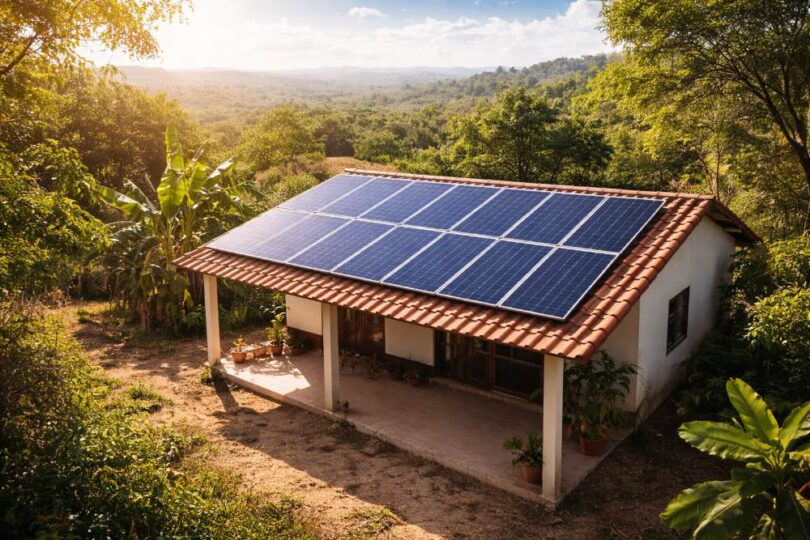
Solar shading and thermal materials could significantly reduce emissions and energy costs in off-grid buildings, according to new research from the University of Surrey.
The study found that combining rooftop solar panels with strategically placed phase change materials (PCMs) in building roofs could cut carbon emissions by between 41% and 54%, while reducing electricity costs to around $0.15 per kilowatt-hour.
The findings highlight a potential low-cost pathway to improve energy access and reduce reliance on diesel generators in remote and rural regions.
Solar shading and thermal materials improve building efficiency
The research examined how solar shading and thermal materials interact to influence energy performance in standalone off-grid buildings in warm climates.
PCMs absorb and release heat as they melt and solidify, helping to regulate indoor temperatures and reduce cooling demand. The study found that placing thin layers of PCM on both sides of roof insulation, combined with shading from rooftop solar panels, delivered the most effective results.
This configuration achieved annual energy savings of 8.75% and significantly reduced emissions compared to conventional roof designs.
Professor Mahmoud Shafiee, Professor in Energy Resilience at the University of Surrey, said: “This study shows that simple, low-cost roof modifications – combined with the natural shading from solar panels – can halve carbon emissions and bring energy costs down to affordable levels.”
Material placement more important than volume
A key finding of the study is that the positioning of PCMs has a greater impact than the quantity used.
In some configurations, placing PCM only on the outer side of the roof increased energy demand, as the material absorbed heat during the day and released it at less useful times.
This suggests that optimised design strategies can deliver better performance with less material, improving cost-effectiveness for deployment in low-resource settings.
Implications for off-grid energy systems
The study modelled building performance using industry-standard simulation tools and integrated energy system planning software to optimise the balance between solar generation, battery storage and backup generation.
Rooftop solar shading accounted for approximately 55% of the total energy improvement, while PCM contributed the remaining 45%, highlighting the importance of combining technologies rather than relying on a single solution.
For more on decentralised energy systems, see our coverage of energy transition technologies.
As many off-grid communities continue to depend on diesel generation, the findings suggest that relatively simple design changes could play a key role in reducing emissions, lowering costs and improving energy resilience.
The full study is available via Renewable Energy journal.