


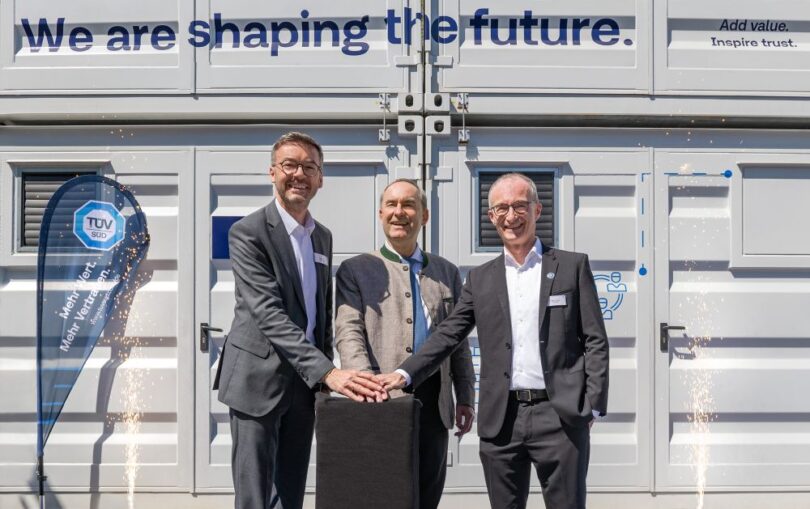
TÜV SÜD hydrogen testing laboratory capabilities are expanding with the opening of a new facility in Garching, Germany, designed to accelerate the safe deployment of hydrogen technologies across global markets.
TÜV SÜD has launched the laboratory to provide testing and certification services for materials, components and complete hydrogen systems, supporting manufacturers from early development through to global market approval.
TÜV SÜD hydrogen testing laboratory strengthens hydrogen safety standards
The hydrogen sector is widely recognised as a key enabler of decarbonisation across energy-intensive industries, transport, and energy storage. However, scaling deployment requires robust safety frameworks, particularly as hydrogen presents unique technical challenges including material embrittlement, leakage risks and extreme operating conditions.
The new TÜV SÜD hydrogen testing laboratory addresses these challenges by offering comprehensive testing across the full product lifecycle. This includes material qualification, validation under stress conditions, and certification aligned with international standards such as ISO and European regulatory frameworks.
Karl Meier, COO of TÜV SÜD Product Service GmbH, said the facility will play a critical role in ensuring hydrogen technologies are safe and market-ready.
“The energy transition needs safe innovations – and hydrogen is a central building block. With our new laboratory, we are creating the conditions to make hydrogen technologies reliable, compliant with standards, and market-ready.”
Advanced testing infrastructure replicates real-world hydrogen conditions
The facility includes high-performance testing systems capable of simulating real operating environments. These include pressure cycling systems capable of exceeding 150 MPa, temperature testing ranging from -40°C to +180°C, and continuous monitoring for leakage and material degradation.
Specialised testing focuses on both metallic and non-metallic materials, assessing hydrogen compatibility and long-term durability. This is critical as hydrogen exposure can lead to cracking, permeation and structural weakening over time.
Additional capabilities include vibration testing for system components, gas flow testing, and combined exposure assessments using hydrogen and alternative gases such as nitrogen and helium.
Supporting global hydrogen deployment and certification
Beyond materials testing, the laboratory supports validation of complete systems, including valves, pressure regulators, pipelines, sensors, tanks and refuelling infrastructure. This enables manufacturers to meet certification requirements across multiple global markets.
The facility operates in accordance with ISO 17025 standards and integrates into broader certification and auditing programmes, helping companies achieve compliance and gain international market access.
At the opening event, Hubert Aiwanger, Bavarian Minister of State for Economic Affairs, Regional Development and Energy, highlighted the role of the facility in supporting hydrogen infrastructure development.
“The new hydrogen testing laboratory is another piece of the puzzle in the roll-out of the hydrogen infrastructure. When TÜV SÜD certifies something, it is safe and recognised worldwide.”
Hydrogen testing as a foundation for the energy transition
The TÜV SÜD hydrogen testing laboratory reflects growing investment in the infrastructure required to scale hydrogen safely. As hydrogen adoption accelerates globally, testing and certification are becoming critical enablers of deployment, ensuring technologies can operate reliably under demanding conditions.
By expanding its testing capabilities, TÜV SÜD is positioning itself within the broader ecosystem supporting hydrogen innovation, industrial decarbonisation and energy system resilience.
More information is available via the official TÜV SÜD newsroom: tuvsud.com/newsroom.
Internal link suggestion: Energy
Image: Karl Meier, COO TÜV SÜD Product Service GmbH; Hubert Aiwanger, Bavarian Minister of State for Economic Affairs, Regional Development and Energy and Deputy Minister-President, and Holger Lindner, CEO TÜV SÜD Product Service Division.