


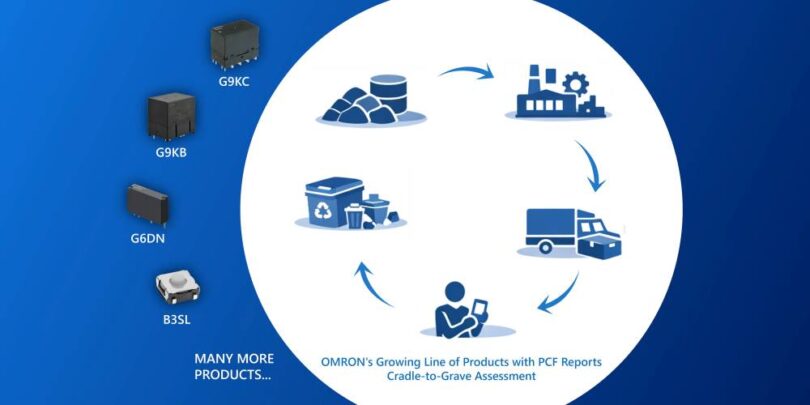
Product carbon footprint reporting in electronic components is expanding as OMRON Electronic Components Europe scales the availability of emissions data across its portfolio.
The move is designed to help manufacturers strengthen supply chain transparency and prepare for forthcoming EU regulations, including the Digital Product Passport (DPP), which will require detailed lifecycle environmental data for products placed on the European market.
OMRON confirmed that product carbon footprint (PCF) data is now available for a growing number of its components, including relay series such as G9KB, G6DN and G9KC, as well as B3SL surface-mount tactile switches. The company is prioritising high-volume product lines to maximise early impact for customers working towards compliance.
Product carbon footprint reporting in electronic components
PCF reporting provides a cradle-to-grave assessment of emissions associated with a product, covering raw material extraction, manufacturing, logistics, use and end-of-life stages. This level of detail is becoming increasingly important as regulatory frameworks and corporate sustainability targets evolve.
OMRON’s reporting programme forms part of its wider DMS Green Project, which focuses on reducing environmental impact across energy consumption, product design and supply chain operations. The initiative reflects a broader industry shift towards embedding sustainability data directly into product development processes.
The company has developed its own PCF calculation tool based on ISO 14067, the international standard for carbon footprint quantification. Depending on the product, results are either independently verified or self-declared to accelerate the availability of emissions data.
Supporting compliance and supply chain transparency
The rollout of PCF data is intended to support manufacturers in meeting new compliance requirements while also enabling more informed design decisions. By providing product-level emissions data, component suppliers can help downstream users reduce overall system carbon footprints.
Applications for the components covered by the programme include industrial automation, energy storage systems, HVAC technologies, EV charging infrastructure and smart building systems, all of which are under increasing pressure to demonstrate measurable sustainability performance.
OMRON is also making its PCF calculation approach available to supply chain partners, supporting wider adoption of standardised carbon reporting methodologies across the electronics sector.
Industry context: carbon transparency in product design
As sustainability regulations tighten globally, product-level carbon transparency is becoming a critical requirement across manufacturing industries. The EU Digital Product Passport is expected to play a central role in this transition by mandating accessible environmental data for a wide range of products.
Within this context, product carbon footprint reporting in electronic components is emerging as a key enabler of low-carbon design, allowing manufacturers to identify emissions hotspots and prioritise reduction strategies.
For more coverage, visit our Technology & Innovation section.