

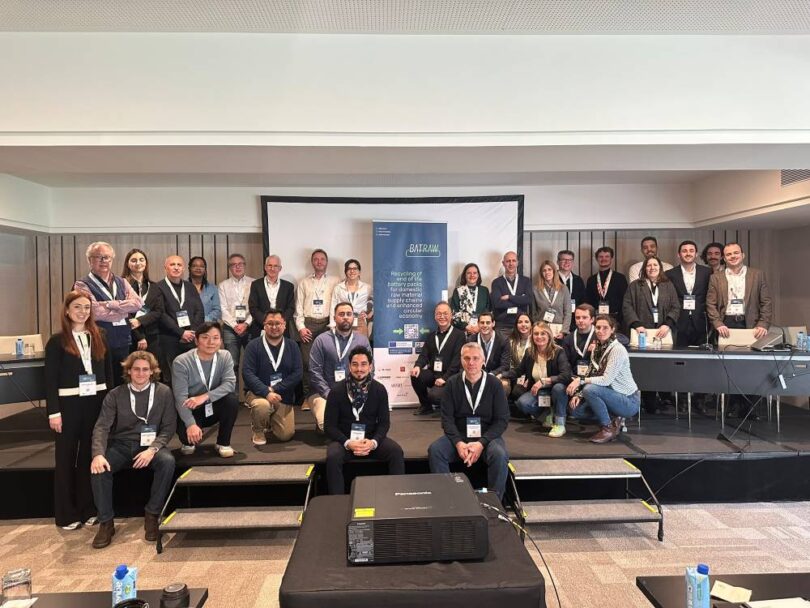
EV battery recycling technologies in Europe are advancing as the BATRAW consortium presented final results from its pilot projects during its third and final innovation workshop in Madrid.
The workshop brought together project partners and external experts to review progress across key areas including battery disassembly, material recovery and sustainability assessment, as the project moves towards commercialisation.
Advancing EV battery recycling technologies in Europe
The BATRAW project has focused on developing and validating new approaches to end-of-life electric vehicle battery management, with two pilot programmes targeting disassembly and material recovery.
One pilot demonstrated improvements in semi-automated battery disassembly, aimed at increasing safety and efficiency when handling end-of-life EV batteries. A second pilot focused on hydrometallurgical recycling processes, improving the recovery of critical raw materials.
Project partners also presented results on the environmental and social performance of these processes, using lifecycle assessment methodologies to evaluate sustainability impacts.
Additional findings highlighted the technical feasibility of producing high-quality recycled materials, including cathode materials such as LNMO and NMC811, as well as recycled graphite for battery anodes.
From pilot validation to industrial scale-up
As the project concludes, the consortium is shifting focus towards industrial validation and scaling up its most promising technologies.
Partners are now working to establish commercial pathways, including collaboration with industry stakeholders and alignment with regulatory frameworks across Europe.
The project aims to support the development of a more resilient battery supply chain by reducing dependence on virgin raw materials and improving recycling efficiency.
Industry context: circular economy and battery material security
The rapid growth of electric vehicles is increasing demand for critical raw materials such as lithium, nickel and cobalt. Recycling is expected to play a key role in securing these materials while reducing environmental impacts.
Innovations in disassembly, material recovery and second-life applications are becoming increasingly important as Europe seeks to build a circular battery economy.
Within this context, EV battery recycling technologies in Europe are evolving to improve recovery rates, reduce costs and support long-term sustainability goals.
For more coverage, visit our Manufacturing & Recycling section.