


Enhanced oil recovery with CCS can combine additional oil production with verified permanent CO₂ storage, but lifecycle assessment is needed to establish the overall climate impact, according to a new Global CCS Institute fact sheet.
The Global CCS Institute has published CO₂-enhanced oil recovery with CCS: the basics, examining how captured carbon dioxide can be used to recover additional oil while some of the CO₂ is permanently stored underground.
The publication distinguishes the process from conventional enhanced oil recovery, where the primary objective is increased oil production, and from dedicated carbon storage projects where permanent geological storage is the sole purpose.
The Global CCS Institute publication also examines the economics of the process, its potential relationship with wider carbon capture and storage infrastructure, and the importance of monitoring and verifying stored CO₂.
How enhanced oil recovery with CCS works
Enhanced oil recovery with CCS begins with CO₂ captured from sources such as industrial facilities and power plants.
The carbon dioxide is transported to suitable oil fields and injected underground, where it can help oil move more easily towards production wells.
Some of the injected CO₂ remains trapped underground. CO₂ that returns to the surface alongside the oil can be separated, treated and reinjected.
Monitoring and accounting are then used to quantify how much carbon dioxide remains permanently stored.
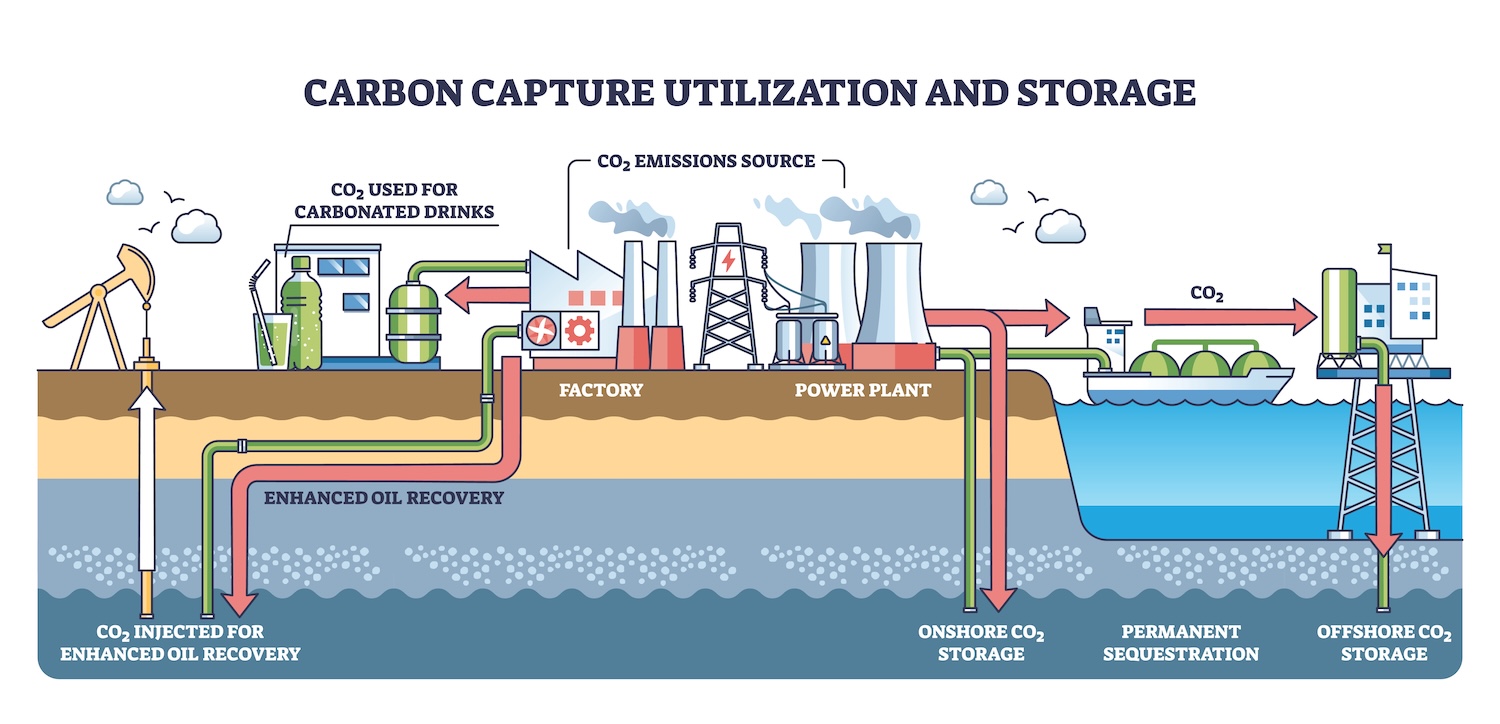
Illustration showing carbon capture, CO₂ transport, enhanced oil recovery and onshore and offshore geological storage. Image: Adobe Stock
Enhanced oil recovery with CCS differs from conventional EOR
The Global CCS Institute says an important distinction exists between conventional CO₂-enhanced oil recovery and projects that incorporate carbon capture and storage.
Traditional CO₂-enhanced oil recovery focuses on increasing oil production. In projects described as EOR with CCS, permanent CO₂ storage is also measured, reported and verified.
Dedicated CO₂ storage differs again because permanent underground storage is the primary objective and no additional oil production is involved.
Richard Leese, Head of Europe at the Global CCS Institute, said:
“There’s an important distinction between CO₂-enhanced oil recovery and EOR combined with CCS that demonstrates permanent CO₂ storage. Our fact sheet explains that distinction and where this approach may support wider carbon capture and storage deployment.
“It also explains the commercial connection. Selling captured CO₂ for oil recovery can help counter capture costs and support the development of transport and storage infrastructure.”
Commercial case could support wider CCS infrastructure
The Institute says revenue from supplying captured CO₂ for oil recovery can, in some circumstances, help offset carbon-capture costs.
It also argues that projects may contribute to the development of transport and storage infrastructure that can later support dedicated geological storage.
Whether that approach is practical depends on factors including local geology, the availability of captured CO₂, transport infrastructure, operating requirements and regulation.
The Institute describes enhanced oil recovery with CCS as a potential transitional route towards dedicated CO₂ storage rather than a model suitable for every location.
Lifecycle assessment needed to establish climate impact
The fact sheet stresses that demonstrating permanent underground CO₂ storage does not by itself prove that an enhanced oil recovery project delivers an overall climate benefit.
The climate impact depends on the emissions associated with the individual project, including the wider lifecycle of the oil produced, capture and transport operations and the amount of carbon dioxide permanently stored.
The Institute therefore calls for consistent project boundaries, transparent reporting and common accounting approaches when climate benefits are assessed.
Leese said:
“Although there can be transitional benefits for climate-focused CO₂ storage, EOR with CCS is not a model for every location. The opportunity needs to be assessed against local conditions, with transparent reporting of the CO₂ stored and a clear explanation of any claimed climate benefit.”
Measurement remains central to permanent carbon storage
The distinction between carbon capture and permanent storage places particular importance on monitoring, reporting and verification.
Accurate measurement is needed to determine how much CO₂ has remained underground rather than simply how much was injected into a reservoir.
Climate Global News has previously covered the role of measurement technology in improving transparency across carbon capture, utilisation and storage projects.
The Global CCS Institute’s latest fact sheet is available through its official website.
Source: Global CCS Institute