

Global lithium-ion battery recycling capacity grew by 77% between 2024 and 2026, according to IDTechEx, the Cambridge, UK-based market intelligence firm, which forecasts that the lithium-ion battery recycling market will reach US$64 billion by 2047. The firm said more than 11 million tonnes of critical battery materials will be available for recovery by 2047.
The figures come from a new IDTechEx report, Lithium-ion Battery Recycling Market 2027-2047: Markets, Forecasts, Technologies, and Players. The analysis, by IDTechEx technology analyst Brandon Frost, covers market developments, the technologies best suited to meeting material supply and demand, and how cathode chemistry and recycling technology affect the economics of recovery.
Supply security and price stability drive demand
IDTechEx presents recycling as a way to source finite critical materials such as cobalt, nickel and lithium without depending on where deposits are located. Virgin production will continue but is limited by geography, the firm said, and diversifying supply chains is becoming more important as the global economy turns increasingly to protectionism.
According to the firm, recycling is becoming more viable as growing numbers of battery electric vehicles reach the end of their life and collection, transport and logistics improve. IDTechEx added that greater supply security could reduce price volatility, while concern over environmentally damaging extraction is pushing governments and industry towards more sustainable sourcing.
The firm described the sector as relatively nascent but expanding rapidly. Climate Global News has previously reported on advances in EV battery recycling under the BATRAW project, which included a pilot focused on hydrometallurgical recycling processes.
Hydrometallurgy leads the capacity boom
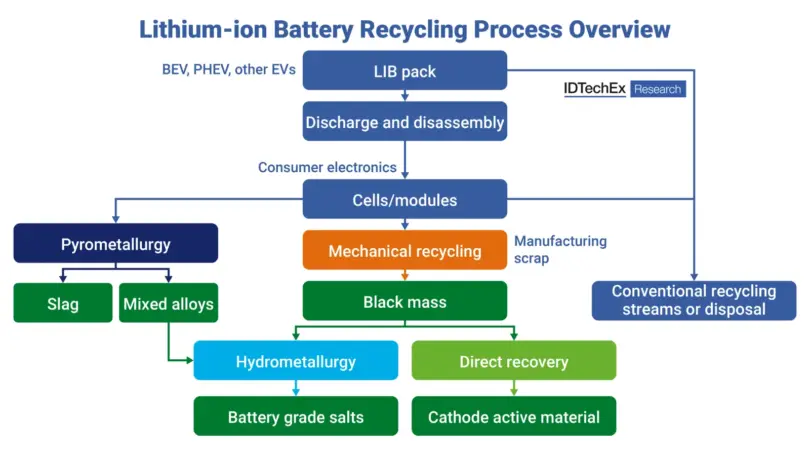
Spent batteries can be processed through mechanical, pyrometallurgical, hydrometallurgical and direct recycling routes. These generate products containing recovered materials that can be further refined and sold back into the market. Repurposing and remanufacturing also reduce waste, but IDTechEx said recycling is the key to closing the loop by returning critical materials to the battery supply chain.
The firm described hydrometallurgical recycling as arguably the most important route. It processes black mass and metal alloys through a series of purification steps to produce salt solutions and high-purity battery-grade salts.
Direct recycling, the least commercialised route, preserves the cathode structure and restores lost capacity rather than destroying the material. IDTechEx also noted growing interest in recycling graphite anodes and electrode binders, although the enabling technologies remain nascent and many processes are proprietary. The report profiles market players including Altilium, OnTo Technology and Tozero, analysing their technologies and future facility plans.
Cathode chemistry shapes recycling economics
IDTechEx expects the industry to be highly profitable, with the market growing at 15.3% per year. Economics depend on the chemistry being recycled: the firm estimates that the value of materials in a 50 kWh NMC811 EV battery cell is 2.3 times greater than that of materials from an LFP EV battery cell.
Other factors include virgin cathode prices, whether a recycler operates a closed-loop or open-loop business model, the scale of operations and available feedstock. The report also examines how recyclers use gate fees to improve economic viability.
In some cases recycling is not the most economical option, IDTechEx said, and second-life batteries can be more cost-effective for pack-level batteries with lower-value cathodes. Even so, the firm expects substantial returns on investment in recycling facilities, with feedstock of spent batteries and manufacturing scrap expected to reach 12.4 million tonnes.
Lithium-ion battery recycling market outlook to 2047
IDTechEx attributes the projected growth to US$64 billion by 2047 to the collection of an increasing number of batteries from electric vehicles. The report provides 20-year forecasts for battery capacity available for recycling (GWh and kilotonnes), recycled critical metals and materials (kilotonnes) and market size (US$ billions).
Forecasts are segmented by sector, covering battery electric vehicles, plug-in hybrids, other EVs, consumer electronics and manufacturing scrap. They are also broken down by material, including graphite, lithium, nickel, manganese, cobalt, aluminium, iron, and aluminium and copper foil.
Chemistries covered include LFP, LMFP, low-, mid-, high- and ultra-high-nickel, Li-Mn-rich, LMNO, LMO and LCO. Further details and sample pages are available on the IDTechEx lithium-ion battery recycling report page.
Frequently asked questions
How much did lithium-ion battery recycling capacity grow between 2024 and 2026?
According to IDTechEx, lithium-ion battery recycling capacity grew by 77% between 2024 and 2026.
How big will the lithium-ion battery recycling market be by 2047?
IDTechEx forecasts the market will reach US$64 billion by 2047, growing at 15.3% per year. It attributes this mainly to the collection of an increasing number of batteries from electric vehicles.
What are the main lithium-ion battery recycling methods?
The main routes are mechanical, pyrometallurgical, hydrometallurgical and direct recycling. IDTechEx describes hydrometallurgical recycling as arguably the most important, while direct recycling is the least commercialised.
Why are NMC batteries more valuable to recycle than LFP batteries?
IDTechEx estimates the value of materials in a 50 kWh NMC811 EV battery cell is 2.3 times greater than that of materials from an LFP EV battery cell. For lower-value cathodes, second-life use can sometimes be more cost-effective than recycling.
How much battery material will be available for recycling?
IDTechEx says more than 11 million tonnes of critical battery materials will be available for recovery by 2047. It expects feedstock of spent batteries and manufacturing scrap to reach 12.4 million tonnes.