


Market intelligence firm IDTechEx has published an analysis of how regulation and government incentives are shaping the business case for carbon dioxide utilisation (CO2U). The Cambridge-based company’s assessment of CO2 utilisation policy, released on 14 October 2026, draws on its Carbon Dioxide Utilization 2026-2036 report, which examines CO2U products and business models.
Carbon capture, utilisation and storage (CCUS) is one of several approaches being scaled up to meet net-zero targets, alongside electrification and renewable power. According to IDTechEx, most new CCUS capacity under construction focuses on permanent geological storage, but utilisation pathways can offer alternative economics.
How CO2 utilisation policy differs by country
IDTechEx said most governments prioritise geological storage from carbon capture over utilisation, as storage can currently handle much larger volumes of captured CO2. Some countries, however, treat CO2 as a raw material for a circular economy.
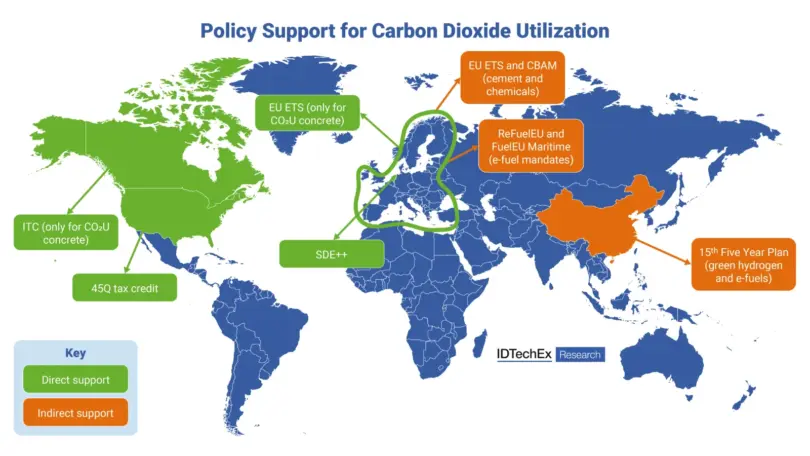
The company cited the United States’ 45Q tax credit as a key example. For CO2 captured from point sources or direct air capture, CO2U credits, typically worth $85 per tonne of CO2, can be claimed for each tonne reduced against a fossil fuel baseline. In 2025, the Trump administration’s “One Big Beautiful Bill” made CO2U credits equal in value to those for dedicated geological storage.
Concrete as both utilisation and storage
IDTechEx said CO2-derived concrete is particularly well placed to benefit from policy because it counts as both utilisation and permanent storage. The mineralisation reaction used to make it produces stable metal carbonates that can lock CO2 away for thousands of years, the company said.
Under the EU Emissions Trading System (EU ETS), carbon pricing does not have to be paid if CO2 is permanently stored. In Canada, the only form of CO2U eligible for the CCUS investment tax credit is the use of captured carbon in concrete production.
Indirect support through decarbonisation rules
The company noted that any decarbonisation policy can indirectly support CO2U, since a key selling point of these products is a lower carbon footprint than fossil-based equivalents. Long-lived products made from biogenic CO2 or CO2 taken directly from the atmosphere can even be net-negative, it said.
On this basis, IDTechEx said the EU ETS and the Carbon Border Adjustment Mechanism (CBAM), which covers cement and chemicals, indirectly strengthen the case for CO2-derived chemicals and concrete.
Mandates for aviation and shipping e-fuels
E-fuels, also known as renewable fuels of non-biological origin (RFNBOs), combine green hydrogen with captured CO2 to make fuels such as kerosene and diesel. IDTechEx’s Sustainable Biofuels & E-Fuels Market 2026-2036 report concludes that, although e-fuels cost far more than HEFA and other biofuel pathways, they will be needed in large volumes for transport to reach net zero by 2050.
The EU’s ReFuelEU Aviation Regulation sets a minimum supply mandate for sustainable aviation fuels, rising from 2% in 2025 to 70% in 2050, with an RFNBO sub-mandate starting in 2030. IDTechEx estimates this could create initial demand for around 1 million tonnes of e-kerosene in the EU alone. The FuelEU Maritime regulation also contains an RFNBO sub-mandate that incentivises CO2-derived methanol.
Outside Europe, the company pointed to China’s green hydrogen sector, with the country’s 15th five-year plan reaffirming a focus on electrolysers and industrial uses such as green ammonia and e-methanol. Many large-scale e-methanol plants are under construction in China, IDTechEx said.
Carbon dioxide utilisation market outlook
IDTechEx forecasts global CO2U market revenue will grow from US$14 billion in 2025 to US$69 billion in 2036, across applications including enhanced oil recovery, fuels, chemicals and concrete. The company said this growth is not driven by policy alone, as some CO2U applications already offer better economics or properties, while others benefit from buyers’ willingness to pay a green premium through carbon credits.
Climate Global News has previously reported on research into recycling industrial carbon dioxide into commercial products. IDTechEx’s wider decarbonisation research portfolio covers related technologies.
Frequently asked questions
What is the 45Q tax credit for CO2 utilisation?
45Q is a US tax credit under which CO2U credits, typically worth $85 per tonne of CO2, can be claimed for each tonne of CO2 reduced compared with a fossil fuel baseline. In 2025 the "One Big Beautiful Bill" made these credits equal in value to those for dedicated geological storage.
Why does CO2-derived concrete benefit from carbon policy?
According to IDTechEx, CO2-derived concrete counts as both utilisation and permanent storage because mineralisation forms stable metal carbonates that can lock CO2 away for thousands of years. It is the only form of CO2U eligible for Canada’s CCUS investment tax credit.
How much e-kerosene could the ReFuelEU Aviation mandate create demand for?
IDTechEx estimates the RFNBO sub-mandate within ReFuelEU Aviation, starting in 2030, could create initial demand for around 1 million tonnes of e-kerosene in the EU alone.
How big is the carbon dioxide utilisation market expected to be?
IDTechEx forecasts global CO2U market revenue will rise from US$14 billion in 2025 to US$69 billion in 2036, covering enhanced oil recovery, fuels, chemicals and concrete.
Is policy the only driver of CO2 utilisation growth?
No. IDTechEx said some CO2U applications already offer better economics or properties, and others benefit from voluntary willingness to pay a green premium through carbon credits.