


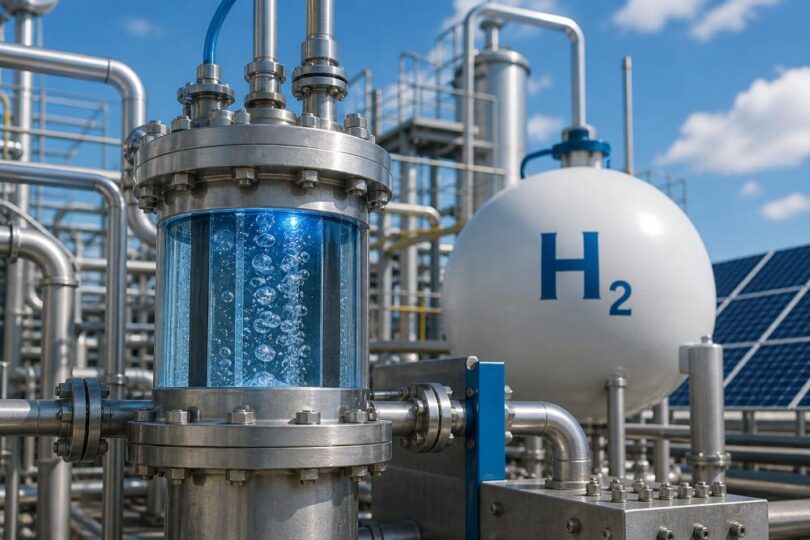
Low-temperature hydrogen production catalyst research from the University of Birmingham demonstrates a new approach to generating hydrogen using significantly reduced operating temperatures.
The study, conducted in collaboration with the University of Science and Technology Beijing, shows that a perovskite-based catalyst can produce hydrogen from water at temperatures between 150°C and 500°C, far below conventional thermochemical processes.
Findings published in the International Journal of Hydrogen Energy indicate the catalyst can also be regenerated at lower temperatures, improving overall process efficiency.
Low-temperature hydrogen production catalyst reduces energy demand
Traditional thermochemical water splitting requires temperatures of 700°C to 1000°C for hydrogen production and up to 1500°C for catalyst regeneration. The low-temperature hydrogen production catalyst developed by the research team reduces these requirements by up to 500°C.
This reduction opens up the possibility of using lower-grade heat sources, including waste heat from industrial sectors such as steel, cement, glass, and chemicals. By utilising existing heat streams, the process could reduce both energy consumption and operational costs.
Hydrogen remains a key focus for decarbonisation strategies, particularly in sectors that are difficult to electrify. However, most hydrogen production today relies on fossil fuels, with steam methane reforming accounting for a significant share of global output.
Thermochemical splitting and industrial integration
Thermochemical water splitting involves using catalysts to separate water into hydrogen and oxygen. While the method avoids direct carbon emissions, its high temperature requirements have limited scalability.
The low-temperature hydrogen production catalyst uses perovskite materials composed of barium, niobium, calcium, and iron. These materials can absorb and release oxygen at lower temperatures, enabling repeated hydrogen production cycles with reduced thermal input.
The study identified a specific formulation, known as BNCF100, as particularly effective, maintaining performance over multiple production cycles with minimal structural degradation.
Lower temperature requirements also support decentralised hydrogen production, allowing facilities to generate hydrogen on-site rather than relying on large-scale infrastructure for transport and storage.
A preliminary cost analysis suggests the approach could be competitive with both green hydrogen, produced via electrolysis, and blue hydrogen, which relies on fossil fuels with carbon capture.
Explore more on our Energy coverage and Technology & Innovation insights.