

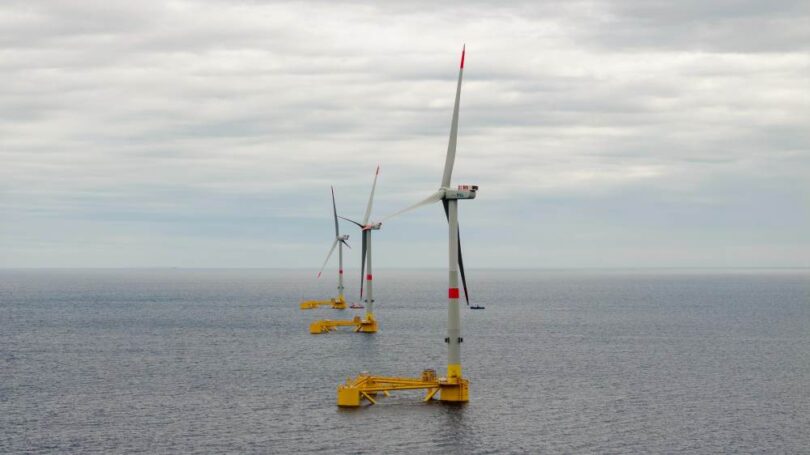
floating offshore wind France project has reached a key milestone as Ocean Winds begins electricity production at its Éoliennes Flottantes du Golfe du Lion (EFGL) site in the Mediterranean.
The 30 MW project, located approximately 16 kilometres off the coast of Port-La Nouvelle, is the company’s first floating offshore wind installation in France and its second globally. Power is now being supplied to the French grid, supporting regional renewable energy demand.
Developed in partnership with Banque des Territoires, the pilot project uses three 10 MW turbines mounted on floating foundations, designed for deployment in deeper waters where traditional fixed-bottom turbines are not viable.
Floating offshore wind France project demonstrates technology maturity
The floating offshore wind France project highlights advances in offshore wind technology, particularly in regions with complex seabed conditions and deeper waters such as the Mediterranean.
Floating wind systems enable turbine deployment in areas previously inaccessible to conventional offshore wind, expanding the potential for renewable energy generation. The EFGL project is expected to generate around 110,000 MWh of electricity annually, equivalent to powering approximately 50,000 people.
The project also reflects growing industrial coordination, with the majority of suppliers based in France or elsewhere in Europe. Local engagement has played a significant role in development, construction, and ongoing operations.
Environmental integration and future expansion
Beyond energy generation, the floating offshore wind France project incorporates environmental measures, including artificial marine habitats designed to support biodiversity around the installation site.
Such approaches are increasingly being explored as offshore wind projects expand, aiming to balance renewable energy development with marine ecosystem protection.
The EFGL project serves as a pilot for future developments, including larger-scale floating wind projects planned in the region. Floating offshore wind is expected to play an increasing role in Europe’s energy transition, particularly in areas where seabed depth limits conventional installations.
As countries seek to scale renewable energy capacity, projects like EFGL demonstrate how floating wind technology can contribute to long-term decarbonisation strategies while supporting regional economies and supply chains.
Explore more on our Energy coverage and Water & Ocean insights.