


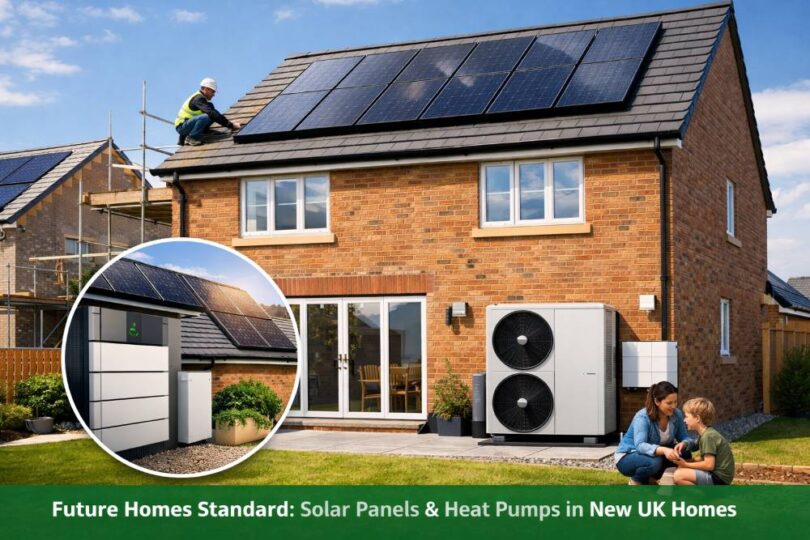
The UK government has confirmed that its forthcoming Future Homes Standard will require the inclusion of low-carbon technologies such as solar panels and heat pumps in the majority of new-build homes, marking a significant shift in housing and energy policy.
The new standard is designed to ensure that homes built from its implementation date are highly energy efficient and equipped to operate without reliance on fossil fuels. By integrating renewable energy generation and low-carbon heating systems from the outset, the policy aims to reduce household emissions, lower long-term energy costs for residents, and support the UK’s wider net zero ambitions.
Under the Future Homes Standard, developers will be expected to prioritise fabric efficiency alongside the installation of technologies such as air source heat pumps and rooftop solar photovoltaic (PV) systems. This approach is intended to minimise energy demand while enabling homes to generate a proportion of their own electricity.
The move comes amid ongoing concerns about energy affordability and security, with policymakers increasingly focused on reducing exposure to volatile fossil fuel markets. Embedding clean energy solutions into new housing stock is seen as a critical step in accelerating the transition to a more resilient and decentralised energy system.
Industry stakeholders have broadly welcomed the announcement, highlighting both the environmental and economic benefits of building low-carbon homes from the ground up.
Nigel Banks, Zero Bills Director at Octopus Energy, said:
“We welcome the government’s Future Homes Standard as a huge step towards greener, cheaper living and a future less reliant on fossil fuels. Heat pumps and solar panels slash bills – so it makes sense to build them into new homes from day one. And with a battery added to the mix, some homes could even pay nothing at all for their home energy. ”
Ed Matthew, UK Director, E3G said:
“To build energy independence we need to build zero carbon homes. The crisis in the Middle East is a reminder of the cost of fossil fuel dependence which threatens to cripple households, drive up fuel poverty and undermine the economy. From 2028, for the first time homes must be built without fossil fuel heating and most will have solar panels. It is a critical step in helping the British people to take back control of their energy from fossil fuel dictators. But the government should have introduced these reforms faster.”
The standard is also expected to stimulate growth across the UK’s clean technology supply chain, including manufacturing, installation, and maintenance services for heat pumps, solar systems, and energy storage solutions.
While the policy has been widely supported, questions remain around delivery timelines, supply chain readiness, and the capacity of the workforce to meet increased demand. Developers and industry bodies are expected to work closely with government to ensure a smooth rollout and to address potential barriers to implementation.
The Future Homes Standard forms a central component of the UK’s strategy to decarbonise buildings, which currently account for a significant proportion of national emissions. Its introduction signals a move towards making low-carbon living the default for new housing, rather than an optional upgrade.
Further details on compliance requirements and timelines are expected to be outlined in accompanying technical guidance.