

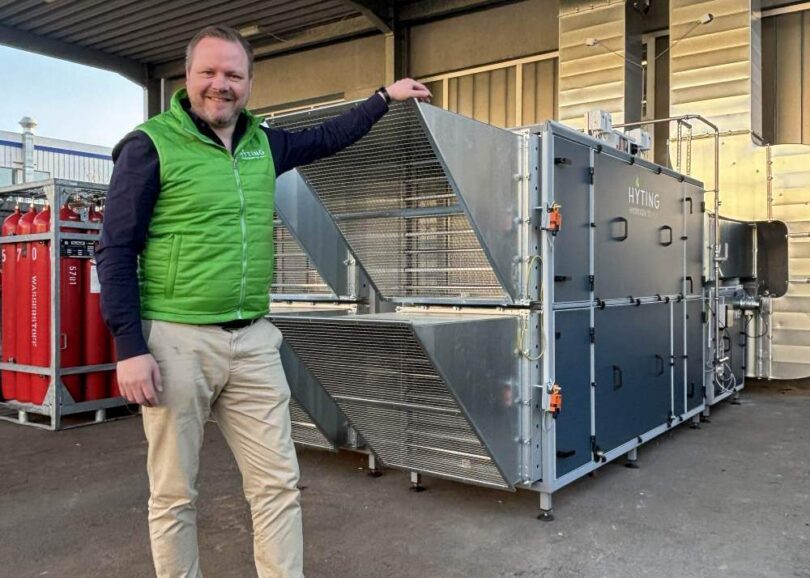
Hydrogen heating systems for industrial buildings are advancing as HYTING commissions its second commercial installation, delivering an 80 kW hybrid heating system at a production facility in Markkleeberg, Germany.
The system consists of two 40 kW air-heating units, each serving separate production areas within a shared industrial site operated by BURO GmbH and Südmetall Schließsysteme GmbH.
This marks a scale-up from HYTING’s first installation and introduces the company’s 50 kW heat generator platform in a commercial setting.
Hydrogen heating systems for industrial buildings in hybrid configuration
The installation operates as a hybrid system alongside a heat pump. The heat pump provides the base heating load, while HYTING’s hydrogen-powered units are used during peak demand or low ambient temperatures.
This approach reduces reliance on grid electricity during peak periods and allows the heat pump to operate more efficiently. According to the companies involved, the system has reduced grid connection capacity requirements and demand charges by approximately 70%.
The hybrid configuration also enables smaller heat pump sizing, lowering both capital expenditure and operational costs while maintaining consistent heating performance.
HYTING said customers can achieve a return on investment in approximately three years under this model.
On-site hydrogen production planned
In the initial phase, hydrogen is supplied externally. However, BURO’s subsidiary, H2 Green Planet GmbH, plans to install an on-site electrolyser later this year to produce green hydrogen.
If implemented, the site would become one of the first commercial facilities to both generate and consume hydrogen for heating on-site, with a target production cost of €4–6 per kilogram.
Tim Hannig, founder and chief executive of HYTING, said the installation demonstrates how modular hydrogen heating systems can scale for industrial applications.
Jürgen Burger, chief executive of BURO, said the system allows peak heating demand to be met without increasing electricity load or emissions, while supporting the company’s broader decarbonisation strategy.
Technology validation and certification
HYTING’s 50 kW heat generator platform has received Gas Appliance Regulation (GAR) certification, following testing by Kiwa, an accredited certification body.
The company also reported completing 2,500 hours of durability testing, simulating approximately 10 years of operation, with no failures or degradation of safety-critical components.
The system is based on a catalytic process in which hydrogen reacts with oxygen to generate heat without combustion. According to HYTING, this results in no CO₂, NOx or particulate emissions, with water vapour as the only by-product.
Industry context: hydrogen’s role in industrial heat decarbonisation
Decarbonising heat in commercial and industrial buildings remains a major challenge. Buildings account for a significant share of energy consumption and emissions, with heating representing a substantial proportion of this demand.
While electrification through heat pumps is a key pathway, hydrogen is increasingly being explored as a complementary solution, particularly for high-temperature or peak-load applications where electrification alone may be less efficient or require costly grid upgrades.
As hydrogen production scales and costs decline, hydrogen heating systems for industrial buildings are expected to play a growing role in reducing emissions across manufacturing and commercial sectors.
For more coverage, visit our Energy section.