

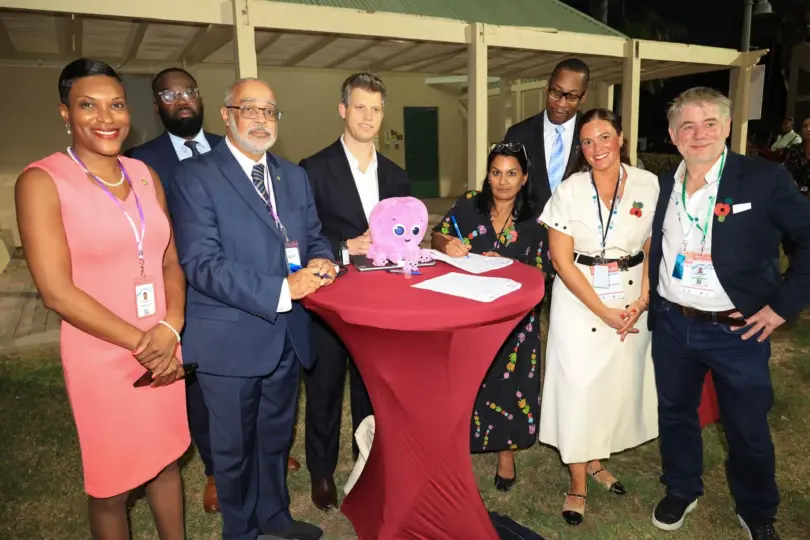
Octopus Energy has launched an Eastern Caribbean Alliance with four regional and international partners. The alliance will explore how small island states can cut their reliance on imported fossil fuels, expand renewable energy and electric transport, and lower energy bills. The agreement was signed on 2 November at the Commonwealth Heads of Government Meeting in St John’s, the capital of Antigua and Barbuda.
The partners are the Organisation of Eastern Caribbean States (OECS), the Eastern Caribbean Central Bank (ECCB), the advocacy organisation Global Citizen and the Sustainable Markets Initiative (SMI). The alliance builds on Octopus Energy’s existing partnership with the Government of Antigua and Barbuda. That partnership is exploring ways of making the country’s energy cheaper, cleaner and more secure.
How the Eastern Caribbean Alliance will work
According to the partners, the alliance will take a whole-system approach. It will examine low-cost clean energy systems for homes, industry and transport, mobilise investment and pool expertise.
By working together, the partners aim to achieve economies of scale in deploying renewable energy, electric vehicles and battery storage. They plan to use technology to manage these assets flexibly and reduce bills.
The OECS is an intergovernmental organisation dedicated to regional integration in the Eastern Caribbean. Its seven full members are Antigua and Barbuda, the Commonwealth of Dominica, Grenada, Montserrat, Saint Kitts and Nevis, Saint Lucia, and Saint Vincent and the Grenadines. Anguilla, the British Virgin Islands, Martinique, Guadeloupe and Saint Martin are associate members. The ECCB was established in October 1983 and is the monetary authority for Anguilla and the seven full members.
Heavy dependence on imported oil and diesel
Around 90% of electricity generation in the Caribbean comes from imported oil and diesel, according to Ember’s October 2026 analysis, Renewable Caribbean: towards energy independence. The partners said this leaves the islands vulnerable to global price shocks and gives them some of the world’s highest energy prices. They also noted that small island nations face the front-line impacts of climate change.
The partners argue that reducing dependence on expensive fossil fuels would allow governments to save money that could ultimately be invested across their economies.
What the partners said
Zoisa North-Bond, chief executive of Octopus Energy Generation, said: “Small island nations face acute challenges from fossil fuel dependence and climate shocks, yet have abundant renewable energy resources.”
She added: “Building on our landmark Antigua and Barbuda deal and their leadership, we’re partnering across the Eastern Caribbean to scale cheap clean energy and electric transport. Together, we can break the price hike cycle, boost energy security and lower bills for communities.”
Dr Didacus Jules, Director General of the OECS, said: “The people of our Member States cannot continue to bear the economic burden of high energy costs and dependence on imported fossil fuels.” He said the OECS would ensure the alliance’s work is “firmly anchored in our regional priorities and the aspirations of our Member States.”
Timothy N.J. Antoine, Governor of the ECCB, said: “Energy security is economic security. Done well, it can ease energy costs for families and businesses and make our economies more competitive. The ECCB welcomes this Alliance as the kind of collaboration the Big Push demands, because no country or institution can do this alone. Now, from discussion to delivery for our people.”
Michael Sheldrick, Co-Founder and Chief Policy, Impact and Government Relations Officer at Global Citizen, said the organisation believes access to reliable, affordable and clean energy must be universal. “Achieving this requires bringing together the private sector, governments and philanthropy, alongside the full range of financing mechanisms – including equity, debt and blended finance to mobilize the capital, expertise and partnerships needed to accelerate the energy transition,” he said.
Jennifer Jordan-Saifi, chief executive of the SMI, which was founded by King Charles III, said: “This Alliance demonstrates the power of partnership to mobilise investment, strengthen energy security and support long-term sustainable growth across the region.”
Part of Octopus Energy’s emerging markets activity
Octopus Energy described the Eastern Caribbean Alliance as the latest step in its emerging markets activity. That activity includes building what the company says is Sierra Leone’s first wind farm, with Idris Elba, to supply low-cost, reliable energy to Sherbro Island.
The group says it operates in 27 countries and runs an £8.5 billion renewables portfolio. Alongside its energy supply business, it operates electric vehicle leasing, heat pump and solar businesses.
Frequently asked questions
What is the Eastern Caribbean Alliance?
It is a partnership led by Octopus Energy with the Organisation of Eastern Caribbean States, the Eastern Caribbean Central Bank, Global Citizen and the Sustainable Markets Initiative. It will explore low-cost clean energy, electric transport and investment to reduce the region’s reliance on fossil fuels and cut energy bills.
Where and when was the Eastern Caribbean Alliance signed?
The agreement was signed on 2 November 2026 at the Commonwealth Heads of Government Meeting in St John’s, Antigua and Barbuda.
How much of the Caribbean’s electricity comes from fossil fuels?
Around 90% of electricity generation in the Caribbean comes from imported oil and diesel, according to Ember. The partners say this leaves the islands vulnerable to global price shocks and high energy prices.
Which countries are members of the OECS?
The OECS has seven full members: Antigua and Barbuda, the Commonwealth of Dominica, Grenada, Montserrat, Saint Kitts and Nevis, Saint Lucia, and Saint Vincent and the Grenadines. Anguilla, the British Virgin Islands, Martinique, Guadeloupe and Saint Martin are associate members.
How does the alliance relate to Octopus Energy’s work in Antigua and Barbuda?
It builds on Octopus Energy’s existing partnership with the Government of Antigua and Barbuda. That partnership explores ways of making the country’s energy cheaper, cleaner and more secure.