


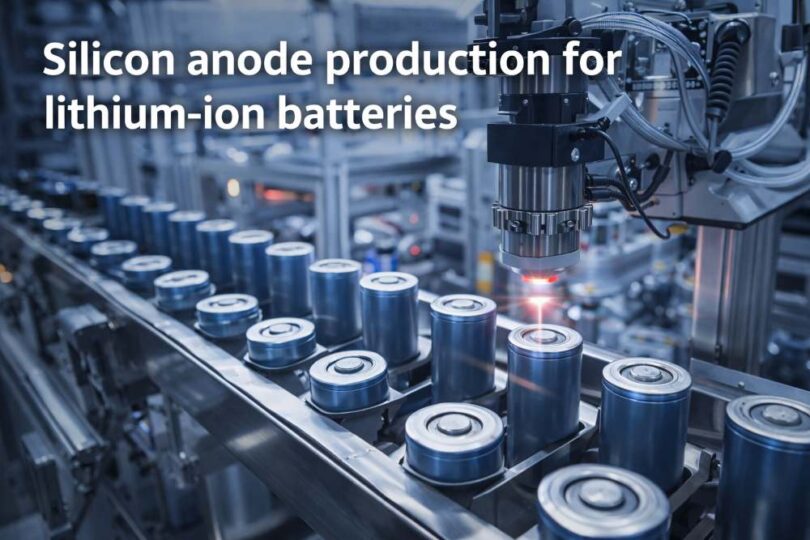
Silicon anode production for lithium-ion batteries is accelerating after GDI secured $15 million in fresh investment to expand manufacturing capacity in the United States and Europe.
The funding round includes participation from W. L. Gore & Associates, InnoEnergy, Impact NY, Helios Climate Ventures, SIA/NOM and other investors. The capital will support initial production lines and help move the company towards early commercial production.
According to the company, two industrial-scale roll-to-roll lines are due to begin initial production this year in Germany and New York State, supporting qualification work across defence, medical technology, consumer electronics and e-mobility applications.
Scaling silicon anode production for lithium-ion batteries
The expansion marks a significant step for silicon anode production for lithium-ion batteries as manufacturers look for higher energy density, faster charging and more resilient supply chains.
GDI said its technology is designed to work with existing lithium-ion cell production infrastructure, which could reduce the time needed for manufacturers to integrate the material into current battery architectures.
The company said third-party lithium-ion cells have achieved 350Wh/kg and 1000Wh/L at a partner defence cell production facility, while also operating at temperatures as low as -40°C without the need for external compression.
Ed Rubin, leader of W. L. Gore & Associates’ venture funds, said: “GDI has developed a differentiated silicon anode platform that pairs breakthrough performance with a capital efficient path to industrial scale.”
Rob Anstey, co-founder and chief executive of GDI, said the latest funding round signalled investor backing for the company’s protected intellectual property, manufacturing pathway and performance claims.
Reducing reliance on graphite in battery supply chains
GDI is focused on replacing graphite in battery anodes, a material that remains widely used across the lithium-ion sector but is increasingly viewed as a supply chain risk.
The company uses Plasma Enhanced Chemical Vapor Deposition (PECVD) in place of conventional mixing, wet coating, drying and calendering steps. GDI said this enables a more streamlined process while drawing on manufacturing techniques already used at scale in sectors such as glass, automotive and energy.
Through its partnership with AGC, GDI is targeting gigawatt-hour scale production by 2031 using North American and European supply chains.
The company said battery cells using its silicon anodes could deliver charging speeds more than three times faster than existing alternatives, along with energy density gains of more than 30% and improved low-temperature performance below -30°C.
Why silicon anodes are drawing industry attention
Silicon anodes are widely seen as a potential next step in lithium-ion battery development because silicon can store more lithium than graphite. However, commercial adoption has been slowed by technical challenges linked to expansion, durability and manufacturability.
As battery makers seek higher performance and more geographically diverse material supply, silicon anode production for lithium-ion batteries is attracting increased investor and industry attention. Technologies that can be integrated into existing production systems may have an advantage as manufacturers try to scale more quickly.
For more climate technology coverage, visit our Technology & Innovation section.