


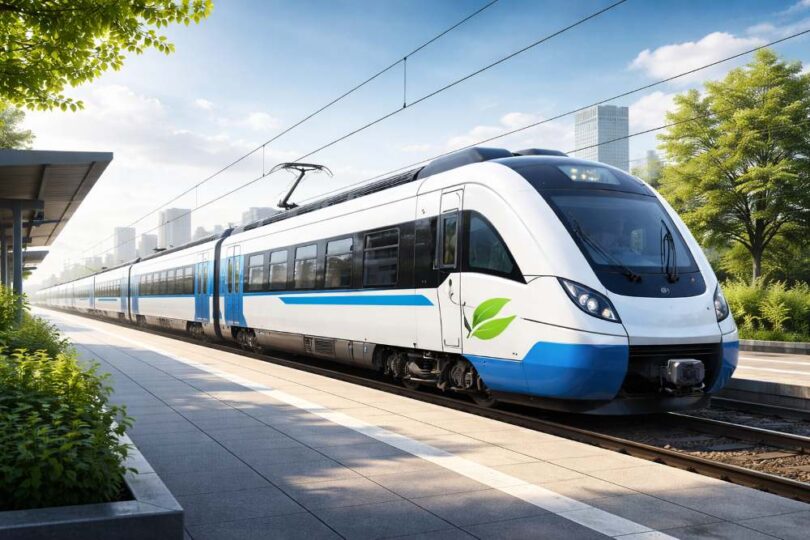
Alternative rail propulsion systems such as battery and hydrogen trains are gaining momentum in Europe’s push to decarbonise transport, but new guidance from TÜV SÜD highlights significant gaps in safety standards that could slow adoption.

alternative rail propulsion systems expert Tolga Wichmann TÜV SÜD rail safety assessor
The organisation has released a new assessment framework aimed at supporting manufacturers, operators and regulators in evaluating the risks associated with emerging propulsion technologies.
The findings are detailed in TÜV SÜD’s newly published guide, Assessment Guide for alternative propulsion systems in rail vehicles, which calls for a more structured and comprehensive approach to safety evaluation.
Alternative rail propulsion systems require system-wide safety approach
The report identifies a lack of harmonised safety standards for alternative rail propulsion systems, particularly for battery and hydrogen-powered trains.
Currently, risk assessments are often conducted at a component level rather than across the full system, creating potential gaps in safety oversight.
The guidance proposes a holistic framework that considers the full lifecycle of propulsion systems, including integration with infrastructure, operational processes and maintenance requirements.
This approach aims to improve transparency and consistency in how risks are assessed and managed across the European rail sector.
Why safety standards matter for rail decarbonisation
Rail is widely viewed as a key pillar of low-carbon transport, but scaling new propulsion technologies introduces technical and regulatory challenges.
Battery and hydrogen systems present different risk profiles compared to conventional diesel or electric rail, including issues related to energy storage, thermal management and system integration.
Without clear and harmonised standards, manufacturers and operators are often required to draw on guidance from other industries, which may not fully address the specific requirements of rail applications.
Establishing consistent safety frameworks is therefore critical to accelerating deployment while maintaining public and operational confidence.
For more on transport decarbonisation, see our coverage of transport innovation.
Industry guidance aims to support deployment of new technologies
The assessment guide is intended for a wide range of stakeholders, including vehicle manufacturers, system integrators, operators, authorities and certification bodies.
It outlines procedures for hazard identification, risk evaluation and approval criteria, while emphasising the importance of independent safety assessment.
According to TÜV SÜD, the goal is to provide practical guidance that supports the safe and efficient deployment of alternative propulsion technologies as Europe accelerates its transition to low-emission rail transport.
The guide also reflects growing industry recognition that technical innovation must be matched by robust regulatory frameworks to enable large-scale adoption.