

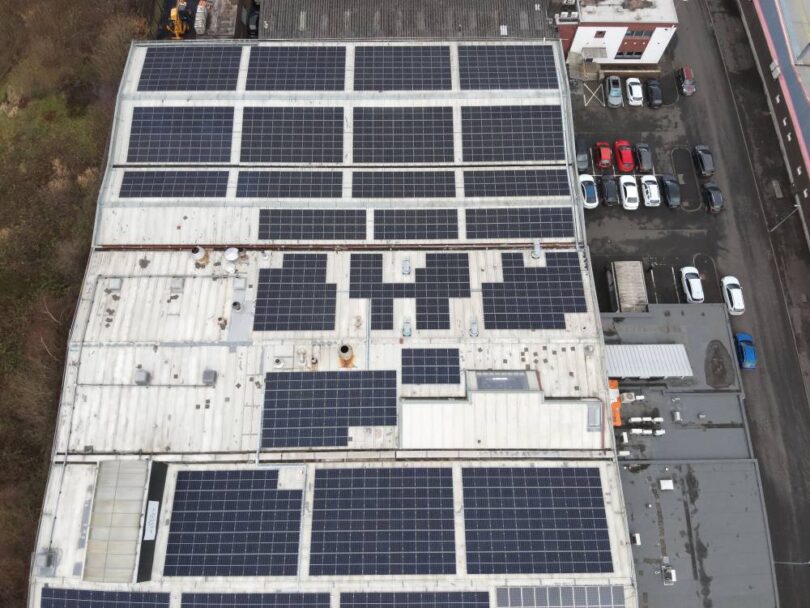
A major rooftop solar installation is helping power energy-intensive coffee roasting operations in Glasgow following a renewable energy upgrade at the Matthew Algie roastery.
The project increased the site’s solar photovoltaic (PV) capacity from 10 kW to 422 kW through the installation of 928 solar panels across eight roofs. The expanded system enables elements of the processing plant to run entirely on renewable electricity.
The installation was delivered by RSK Renewables, part of the RSK Group.
Lewis Doyle, Senior Project Manager at RSK Renewables, said the upgrade builds on an earlier renewable energy investment made by the business more than a decade ago.
“The solar installation at Matthew Algie’s roastery is the second significant renewable energy project the business has embarked on. In 2012, it installed a 10 kW system, which it has now upgraded to have the capacity to power a significant proportion of its operations.”
Engineering design tailored for energy-intensive roasting process
Because coffee roasting requires significant amounts of energy, engineers designed the solar system to integrate with the factory’s operational requirements.
Oluwafemi Sadugba, Senior Solar Design Engineer at RSK Renewables, said the project involved multiple engineering stages including structural assessments, electrical design and grid compliance.
“The design for the new array incorporated multiple engineering processes, from structural assessments, electrical design and grid compliance to fire safety and regulatory compliance. Because coffee roasting is a highly energy-intensive process, the specific needs of the factory to function effectively were considered in the design.”
Detailed roof surveys were undertaken to assess structural capacity, wind uplift resistance and accessibility for maintenance and emergency response.
The design also accounted for potential shading constraints and ensured that the mounting system complied with UK wind load standards under European technical guidelines.
Structural surveys and fire safety built into project
Additional structural engineering support was provided by Acies, another company within the RSK Group.
Emily Taylor, Technical Director at Acies, said the project required both pre- and post-construction structural assessments to ensure the building could safely support the expanded solar array.
“A comprehensive pre-installation survey was carried out across the roof and supporting structures that the PV installation would be fitted to.”
“Following this, a comparative structural back-analysis was undertaken for the provision of a Structural Engineers Registration (SER) certificate to confirm the suitability of the design and loading capacity of the existing structures.”
Fire safety was also integrated into the system design, including firefighter access routes, spacing between arrays and clear circuit identification.
A linear heat detection system was installed to monitor potential overheating across the solar equipment.
The system operates on a zonal basis, enabling early detection of excessive heat. If temperature thresholds are reached, the system automatically shuts down the installation to minimise fire risk.
Installation completed while factory remained operational
The installation was carried out while the roastery remained fully operational, requiring additional safety and hygiene procedures.
Project teams implemented enhanced personal protective equipment requirements to comply with food processing standards inside the facility.
Engineers working inside the building were required to wear hair nets and full protective suits to maintain hygiene standards during the installation works.
The project highlights the growing role of rooftop solar installations in supporting industrial decarbonisation across manufacturing sectors.