


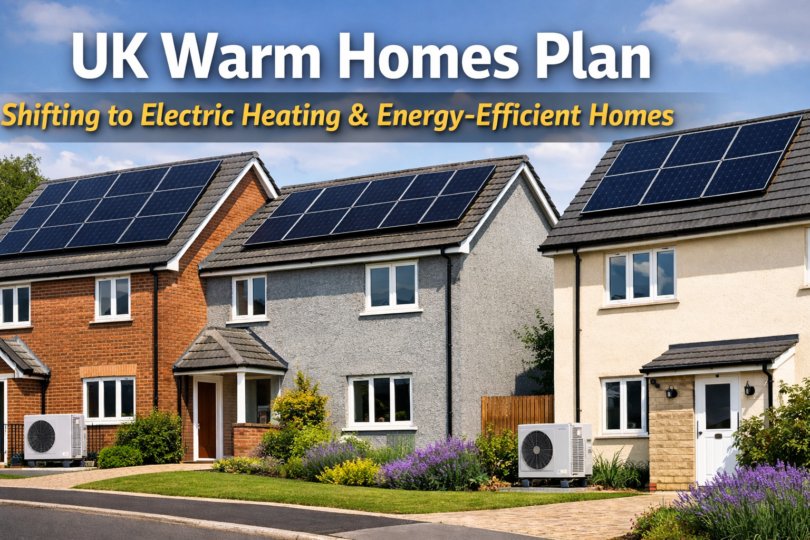
The UK Warm Homes Plan is set to mark a significant moment in the government’s approach to domestic energy, with £15 billion committed to improving household efficiency, lowering energy bills and accelerating the transition away from fossil fuel heating.
As details of the UK Warm Homes Plan are published, industry leaders and policy experts have broadly welcomed the direction of travel, while cautioning that further measures will be needed to ensure vulnerable households are fully protected.
UK Warm Homes Plan and the electrification of homes
Greg Jackson, Founder of Octopus Energy, described the plan as a decisive step towards more affordable and stable household energy.
“The Warm Homes Plan is a really important step forward. Electrifying homes is the best way to cut bills for good and escape the yoyo of fossil fuel costs.
Solar panels can slash energy costs – and paired with a battery we get the electricity when we need it. Heat pumps can be cheaper to run, and with solar they’re often dramatically cheaper. With the right finance, simpler rules and a big push from manufacturers, heat pumps will increasingly be the best solution for many homes – as they are in other countries like Sweden, Norway and Finland.
We still need to focus on getting electricity costs lower for everyone, building on the changes in the budget, but this plan sends a clear signal that the future of home heating is electric.”
Electrification, particularly through heat pumps combined with rooftop solar and battery storage, is increasingly seen as central to reducing long-term household energy costs while cutting emissions from the housing sector.
Efficiency standards and fuel poverty concerns
Independent climate think tank E3G also welcomed the emphasis on building efficiency, highlighting the potential impact for renters and low-income households.
“Stronger building efficiency standards will be life-changing for many renters – slashing their bills by hundreds of pounds a year, as well as keeping their homes drier and healthier.
But more still needs to be done to protect households with electric heating, who are twice as likely to face fuel poverty as other households.”
The comments underline a key challenge facing the UK Warm Homes Plan: ensuring that electrification and efficiency upgrades translate into lower costs for all households, particularly those already reliant on electric heating.
A clear direction, with challenges ahead
Together, the responses from industry and policy experts suggest the plan provides long-term clarity on the future of home heating in the UK, while also highlighting areas where further reform will be required. Electricity pricing, targeted support for vulnerable households and consistent efficiency standards are expected to remain central to the policy debate as the plan moves into delivery.