


Public support for expanding hydrogen fuel cell heavy-duty trucks in South Korea is strong enough to outweigh the cost of carbon reduction, according to new research published in the journal Transport Policy.
The study assesses whether households would be willing to pay to support a national plan to replace conventional diesel freight vehicles with hydrogen fuel cell alternatives, a key pillar of South Korea’s transport decarbonisation strategy.
Public acceptance of hydrogen freight transition
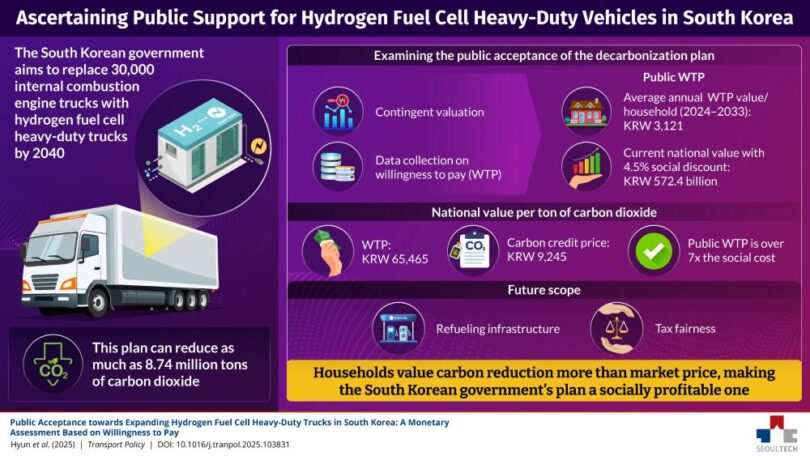
South Korea has set a target to deploy 30,000 hydrogen fuel cell heavy-duty trucks by 2040, replacing a significant share of internal combustion engine vehicles in the freight sector. If achieved, the transition is expected to reduce carbon dioxide emissions by approximately 8.74 million tonnes.
To assess public acceptance, researchers conducted one-to-one interviews with 1,000 households across South Korea in 2024, using a contingent valuation method to estimate willingness to pay through annual income tax contributions.
Willingness to pay exceeds carbon costs
The analysis found that households were willing to pay an average of KRW 3,121 per year between 2024 and 2033 to support the expansion of hydrogen trucks. When aggregated nationally and discounted at a social discount rate of 4.5%, this equates to a present value of approximately KRW 572.4 billion.
In carbon terms, the estimated willingness to pay per tonne of carbon dioxide reduction was KRW 65,465, more than seven times higher than the prevailing carbon credit price of KRW 9,245 per tonne.
According to the researchers, this indicates that the proposed policy delivers net social benefits, even when accounting for the high upfront costs associated with hydrogen vehicles and refuelling infrastructure.
Infrastructure and policy considerations
The study also highlights practical barriers to large-scale deployment. Hydrogen refuelling stations in South Korea are currently concentrated at bus depots, limiting accessibility for freight operators.
The authors recommend expanding refuelling infrastructure along major logistics corridors and aligning acquisition tax incentives for hydrogen trucks with those already available for hydrogen buses.
Implications for transport decarbonisation
The findings suggest that public acceptance may not be the primary barrier to hydrogen freight adoption. Instead, infrastructure rollout and policy design are likely to play a decisive role in determining whether hydrogen fuel cell trucks can scale rapidly enough to contribute meaningfully to emissions reduction.
The research adds to growing evidence that households value climate mitigation benefits more highly than current market signals, strengthening the case for government intervention in hard-to-abate transport sectors.