


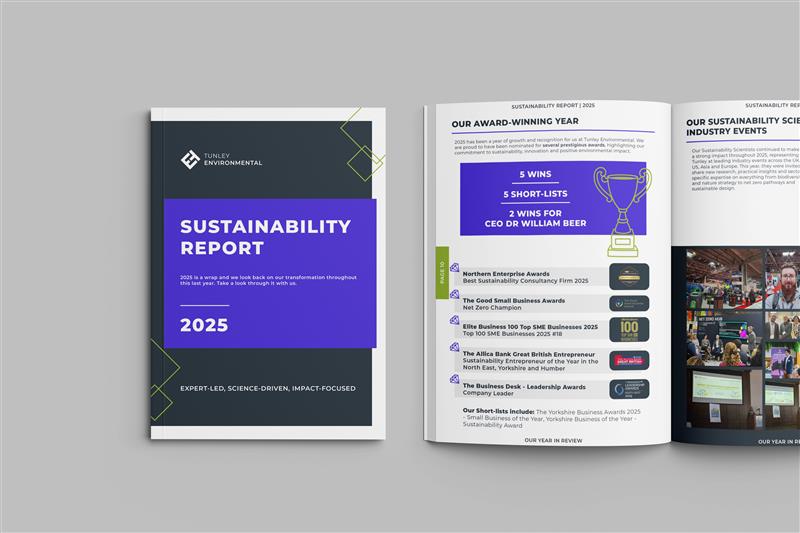
Environmental consultancy Tunley Environmental has published its 2025 Sustainability Report, examining key developments in climate action, biodiversity, regulation and corporate sustainability performance over the past year.
The report provides an overview of how environmental policy, disclosure requirements and nature-related risks are reshaping business decision-making, while identifying the challenges likely to influence sustainability strategies in 2026 and beyond.
Climate, nature and regulation in focus
Authored by Tunley Environmental’s team of scientists and sustainability specialists, the report draws on data analysis, regulatory tracking and client experience across multiple sectors. It reflects the growing convergence between climate mitigation, nature protection and corporate governance.
Key themes explored in the 2025 edition include progress in carbon reduction and renewable energy deployment, increasing attention on climate adaptation, and the integration of biodiversity considerations into corporate reporting and decision-making.
Evolving compliance and reporting requirements
The report also reviews the rapidly changing regulatory landscape affecting organisations operating in the UK and internationally. This includes developments linked to the Corporate Sustainability Reporting Directive (CSRD), the UK’s Procurement Policy Note PPN 006, global biodiversity frameworks, and updated guidance from the Science Based Targets initiative (SBTi).
According to the analysis, regulatory alignment and data credibility are becoming increasingly central to risk management, investor confidence and supply chain transparency.
Insights from COP30 and outlook for 2026
The report reflects on outcomes from COP30, with particular attention given to nature-positive pathways, climate resilience financing and the need to address climate and biodiversity loss together rather than as separate challenges.
A forward-looking section outlines the opportunities and risks organisations may face in 2026, including tightening disclosure expectations, advances in environmental data systems and the growing role of nature-related financial risk assessments.
Commenting on the publication, Dr William Beer, Chief Executive Officer of Tunley Environmental, said:
“2025 has seen significant regulatory change alongside a growing recognition that climate and nature must be addressed together. As we move into 2026, organisations will need robust data, credible reporting and a clear understanding of how policy and environmental risk intersect.”
The Sustainability Report also summarises Tunley Environmental’s own activities during the year, including knowledge-sharing initiatives such as open webinars and guidance materials aimed at improving sustainability understanding across industry.
The 2025 Sustainability Report is available via Tunley Environmental’s website.