

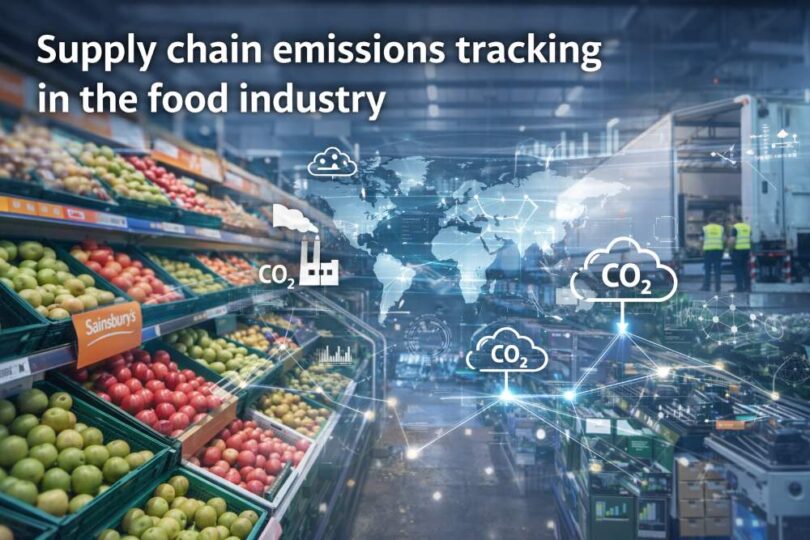
Supply chain emissions tracking in the food industry is advancing as Sainsbury’s partners with Foodsteps to improve how environmental impacts are measured and reduced across its product portfolio.
The partnership is intended to create a more detailed and auditable data ecosystem, helping the retailer move beyond broad estimates towards measurable emissions reductions across its supply chain.
Sainsbury’s said the collaboration supports its wider sustainability strategy, including its commitment to reach net zero across its value chain by 2050.
Advancing supply chain emissions tracking in the food industry
The partnership centres on the use of product-level data and supplier engagement tools to improve transparency and decision-making.
Foodsteps will provide science-based data alongside its AI-enabled Supplier Hub, which is designed to collect sustainability data directly from suppliers at scale. The aim is to make sustainability a more central part of supplier interactions while improving data accuracy.
The companies said the system will allow Sainsbury’s to assess its full product range in greater detail and improve visibility across environmental impacts in its supply chain.
Anya Doherty, founder of Foodsteps, said: “We are incredibly excited to partner with Sainsbury’s on its ambitious Plan for Better journey. At Foodsteps, we are on a mission to empower the food industry to accelerate its transition to net zero.”
Stephanie Lambert, managing director of Foodsteps, said scalable data infrastructure is essential to driving collaboration across complex supply chains.
Driving measurable decarbonisation across food supply chains
The food sector faces growing pressure from climate change, biodiversity loss and supply chain disruption. The partnership aims to turn sustainability commitments into measurable and reportable outcomes.
Ruth Cranston, director of sustainability at Sainsbury’s, said: “As the food system faces mounting pressures from climate change and wider global uncertainty, it’s more important than ever that we work together to drive the resilience and sustainability of our supply chain. By partnering with Foodsteps, we gain higher quality carbon data that will help us track our emissions reductions and advance our ambitions to protect and restore nature.”
The companies said improved data visibility will support supplier engagement and enable more targeted emissions reduction strategies across the supply chain.
Why food supply chain data is becoming more important
Efforts to reduce emissions in the food sector are increasingly focused on improving data quality and transparency at product level. Traditional reporting methods often rely on averages or industry benchmarks, which can limit the ability to identify targeted reduction opportunities.
More granular data systems allow retailers and suppliers to better understand emissions hotspots, improve reporting accuracy and prioritise interventions across sourcing, production and distribution.
As regulatory scrutiny and investor expectations increase, supply chain emissions tracking in the food industry is becoming a more important part of climate strategies for major retailers and food producers.
For more coverage, visit our Agriculture section.