


Researchers at Tokyo University of Science have uncovered how scandium doping can significantly extend the cycling stability of sodium-ion battery cathodes, offering a pathway to cost-effective and long-life alternatives to lithium-ion batteries.
Layered sodium manganese oxides (Na2/3MnO2) are considered promising cathode materials for high-capacity sodium-ion batteries. While abundant and free from rare-earth metals, these materials suffer from rapid capacity loss during cycling, largely due to Jahn–Teller distortions that weaken their crystalline structure over time.
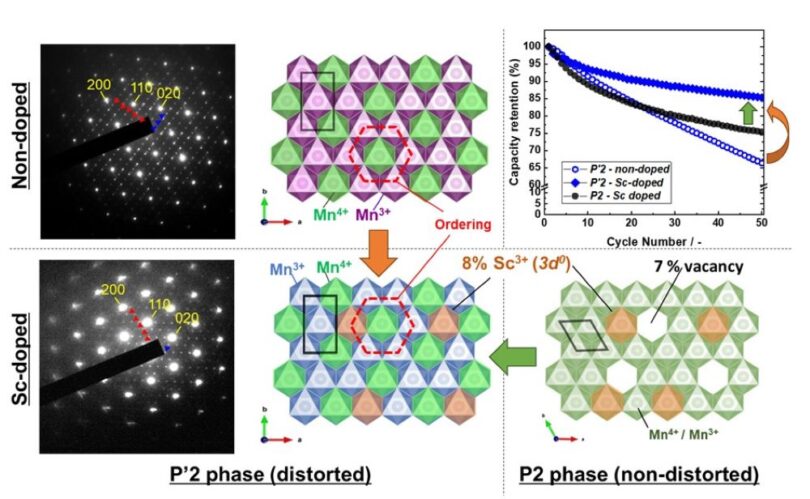
A team led by Professor Shinichi Komaba, together with Mr. Kodai Moriya and Dr. Shinichi Kumakura from the Department of Applied Chemistry, investigated the effects of scandium (Sc) substitution in different crystal structures of Na2/3MnO2. Their findings, published in Advanced Materials, show that Sc doping stabilises the P’2 polytype of Na2/3MnO2 by modulating particle size, altering crystal growth, and preserving cooperative Jahn–Teller distortion. This structural stability leads to a dramatic improvement in cycling performance.
In half-cell tests, electrodes with 8% Sc doping showed optimal stability, maintaining crystallinity and resisting side reactions with electrolytes. The team also demonstrated that pre-cycling further enhanced capacity retention. In full coin-cell prototypes, the doped electrodes achieved 60% capacity retention after 300 cycles, a significant step towards commercial viability.
Interestingly, the stabilising effect was not observed in the P2 polytype, nor with doping using other cations such as ytterbium or aluminium. This highlights the unique role of scandium in improving sodium-ion battery performance.
Although scandium is a costly element, the study demonstrates how even small amounts can unlock a new design strategy for sodium-ion batteries. The research not only advances sodium-ion technology but also contributes to wider efforts to create sustainable, high-performance energy storage solutions.