


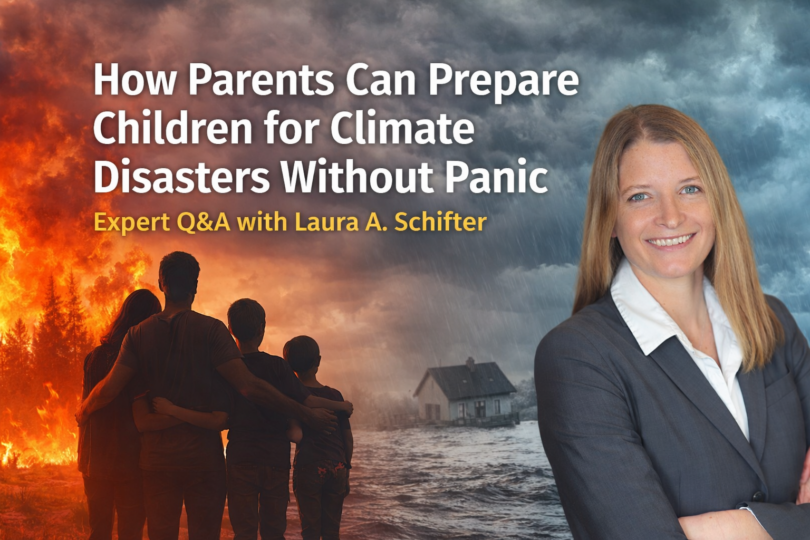
As climate-related disasters intensify and headlines grow more urgent, many parents are asking the same question: how do we protect our children without becoming overwhelmed?
From extreme heat and wildfire smoke to flooding and power outages, the realities of a changing climate are becoming part of everyday family life. Yet preparedness does not have to mean panic-buying or catastrophic thinking. Instead, experts increasingly emphasise resilience, communication and practical planning.
Laura A. Schifter, EdD, a senior fellow at the Aspen Institute and leader of the This Is Planet Ed initiative, has spent years working at the intersection of education, policy and climate action. In this Q&A, she shares clear, grounded guidance for parents navigating climate risk, climate anxiety and the role schools and communities can play in protecting children while empowering the next generation.
For parents who feel overwhelmed by the scale of climate disasters, what are the most important first steps they can take this year to protect their children—without panic-buying or over-prepping?
When climate-related events feel overwhelming, the most important first step for parents is to focus on preparedness, rather than panic. We can’t do our best to protect our kids when we feel panicked. The first steps parents should consider include:
Start by understanding your likely climate risks. Climate impacts look different depending on where you live. Some communities are more vulnerable to flooding, others to extreme heat, drought, wildfire smoke, or storms. Knowing the most likely risks in your area helps you plan in a realistic, targeted way.
Make a simple family emergency plan. Make a basic emergency plan for your family for the most likely risks in your area. Talk through where you’d go, how you’d stay in touch, and what helps your kids feel safe in an emergency.
Talk with your children about what’s happening and what you can do together. Open, age-appropriate conversations help kids feel included rather than left alone to imagine the worst. Focus on what your family can do at home, in your community, and through your school to stay safe and care for others.
Talk to the adults and systems that care for your child. Ask your child’s school, camp, or sports program what plans they have in place for extreme heat, poor air quality, storms, or other climate-related disruptions. Knowing there are clear protocols, or pushing for them if needed, can be just as important as anything you do at home.
How should parents talk to children about climate-related disasters in an age-appropriate way (e.g., ages 4–7, 8–12, teens)? What language is helpful, and what should we avoid?
Parents don’t need one perfect script to talk about climate-related disasters. What matters most is creating an open dialogue so children feel comfortable sharing their concerns and asking questions. I often ground these conversations in four simple climate principles we developed with The Nature Conservancy and its chief scientist Katharine Hayhoe: Earth is our home; Earth is getting hotter because of us; our climate is changing now and that harms us; but together, we can build a brighter future. These ideas can be adapted for any age.
Across all ages, it helps to:
- Connect problems to solutions, emphasizing how people are working to make communities safer and more resilient. For younger kids, language like “look for the helpers” and “we can be helpers too” builds both security and agency.
- Highlight collaboration and community, reinforcing that climate challenges are addressed together, not alone.
- Make climate impacts relatable and relevant. A young child may not grasp a heatwave in another country, but they can understand why extreme heat makes their playground unsafe for play.
Across all ages, it’s important to avoid:
- Problems without solutions or doomerism, which can create fear and helplessness.
- Putting the burden on young people to be the ones who have to “fix” climate change. We need to work alongside young people to act, not put the weight of the issue on their shoulders.
- Over-emphasizing individual action. Balancing personal choices with collective and systemic action helps prevent feelings of shame or blame.
Climate anxiety is rising. What are the key warning signs that a child’s worry has moved from “normal concern” into anxiety that needs extra support? What practical strategies help in the moment?
Climate change brings real uncertainty, and feelings like worry, sadness, grief, or fear are all normal responses, especially for kids. Having these emotions doesn’t mean something is wrong. And supportive parents and caregivers are one of the most powerful protective factors in helping kids process their feelings and build resilience. Open conversations with kids is one of the best ways to stay tuned in to their emotional well-being.
Feelings can shift into anxiety that needs extra support when it starts to impact daily life. Parents should look out for warning signs like trouble sleeping, increased clinginess, withdrawal from play, or a sense of overwhelming hopelessness. Staying in open conversation with your child helps you notice these changes early. If these signs are showing up consistently at home or school, it’s important to seek support from a pediatrician or school-based health professional.
In the moment if your child says they are worried, there are also practical things parents can do to help. Let them know it is OK to feel worried and that they’re not alone. Ask them what questions they might be thinking about, and answer their questions in clear and simple ways. Reassure them they are safe right now. Limiting exposure to scary news or social media can also help.
Ultimately, a parent’s goal should be to help kids feel supported, capable, and less alone as they navigate our changing world.
Wildfire smoke, extreme heat, and winter storms are increasingly common. What are your go-to “stay safe” recommendations for each of these scenarios?
When it comes to heat in particular, many tragedies are preventable when people, including kids, know the early signs of heat illness and what to do next. This is especially important for children playing sports or spending long periods outdoors.
I encourage families to remember four simple steps:
- Prepare: Hydrating should start early. Kids should drink water regularly leading up to hot days, practices, or games.
- Speak up: Teach kids to recognize early signs of heat illness, such as dizziness, nausea, headache, muscle cramps, confusion, or fast breathing. If they notice these symptoms, they should tell an adult right away.
- Sit out: Pushing through heat can be dangerous. Kids need to hear clearly that when their body says “stop,” sitting out is the right and responsible choice.
- Cool down: Once they sit out, they should move to shade or air conditioning, remove extra layers, and actively cool their body with water, cold towels, or ice packs.
Awareness, understanding, and clear steps for action can help all of us prepare for uncertainty.
What does meaningful climate education look like today—especially education that leads to empowerment rather than fear?
Education that empowers students helps connect learning with agency. Specifically, schools can:
- Build climate understanding, knowledge, and skills. Schools can ensure students have a foundational understanding and help students develop deeper understanding by teaching about climate across different classes. Social studies can explore climate impacts on economies, communities, and policy. Science can explain physical systems. The arts can offer space for creativity and emotional processing. Just as importantly, schools should teach media literacy so students can evaluate sources, distinguish credible science from misinformation, and avoid the anxiety that comes from confusion or exaggeration.
- Support students’ emotional well-being. Supportive relationships with adults are powerful, whether that’s a parent, an educator, a coach, or a school counselor. Ensuring schools foster supportive relationships and have mental health supports for students, before, during, and after climate events can help address anxiety.
- Model solutions. By modeling solutions, whether through adding solar, transitioning to electric school buses, or having plans in place to adapt to climate instability, schools can show students how to advance solutions and that adults in their community are taking action. This not only inspires hope, but also helps young people know they aren’t alone in caring about the future.
- Empower students in developing agency. Providing opportunities for students to engage in project-based learning or advocacy efforts connects learning to real-world change. Engaging students can shift feelings of helplessness or hopelessness towards empowerment. This is one of the most powerful ways to address climate anxiety.
If you could give parents one “steadying message” to carry into this year, what would it be?
You don’t have to do everything. You don’t need to be an expert. And you don’t need to be a perfect activist. You just need to be an active parent who shows up calmly, consistently, and honestly. Your presence, your willingness to talk, and your ability to model care and problem-solving are powerful protective factors for your kids. You already have the skills you need to help your kids navigate our changing world.
As climate risks evolve, the conversation is shifting from fear to preparedness, and from isolation to collective action. For families, that shift begins not with grand gestures, but with steady steps: understanding local risks, building simple plans, maintaining open dialogue and strengthening community systems around children.
Schifter’s message is ultimately one of agency without burden. Children do not need to carry the weight of solving climate change. They need adults who are prepared, calm and engaged — and institutions that take resilience seriously.
In a year likely to bring further climate-related disruption, that steadiness may be one of the most powerful forms of protection.