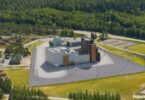



A former coal mining site near Dunfermline in Fife has been redeveloped into a large-scale solar and battery energy facility, marking a shift in land use from fossil fuel extraction to renewable power generation.
The solar farm, developed by Pennon Power, is located on land historically associated with the Fife Coalfield, one of Scotland’s most intensively mined regions during the 18th and 19th centuries.
Solar generation and battery storage
The Dunfermline site covers approximately 100 acres and includes around 80,000 solar photovoltaic panels. Once fully operational, it is expected to generate enough electricity to power the equivalent of 15,000 homes each year.
The development also includes a 30 MW, two-hour battery energy storage system, designed to store surplus electricity and support grid stability. According to Pennon, the battery has sufficient capacity to power the Group’s operations for more than an hour.
Battery storage is increasingly seen as a critical component of renewable energy infrastructure, enabling intermittent generation such as solar to better align with demand.
Reusing former industrial land
The solar farm sits within an area formerly dominated by coal extraction, with historical records indicating the presence of multiple pits and collieries across the site. Mining activity in the Fife Coalfield shaped the landscape and local economy for centuries before declining in the 20th century.
The redevelopment reflects a broader trend across the UK of repurposing former industrial land for low-carbon energy generation, avoiding the use of undeveloped land while supporting regional transition away from fossil fuels.
Part of a wider renewable portfolio
The Dunfermline project is one of two new solar farms recently commissioned by Pennon Power in Scotland. A second site at Cullerlie, near Aberdeen, includes approximately 26,000 solar panels across nearly 50 acres and is already generating electricity for around 5,000 homes.
Together, the two sites are expected to deliver renewable electricity equivalent to around 20,000 homes annually.
Susan Davy, Chief Executive Officer of Pennon Group, said the projects demonstrate how former industrial land can contribute to a low-carbon energy system:
“Taking land that once powered the past and using it to generate clean electricity reflects the role infrastructure can play in supporting communities and reducing emissions as the energy system changes.”
Supporting water services and emissions reduction
Pennon Group owns several UK water companies, including South West Water, Bristol Water, Bournemouth Water, SES Water and Isles of Scilly Water. The Group uses renewable electricity across treatment works, pumping stations and reservoirs.
By expanding its own renewable generation capacity, Pennon aims to reduce operational emissions and exposure to energy price volatility. When all four of Pennon Power’s planned solar sites are operational by 2027, the portfolio is expected to generate electricity equivalent to approximately 40% of the Group’s total consumption.
Biodiversity and community features
The Dunfermline solar farm includes a range of environmental and community measures, including habitat enhancements to support wildlife, landscaping shaped to reflect the site’s industrial history, and managed sheep grazing to maintain vegetation.
A community fund linked to the project is intended to support local schools and community groups in the surrounding area.