


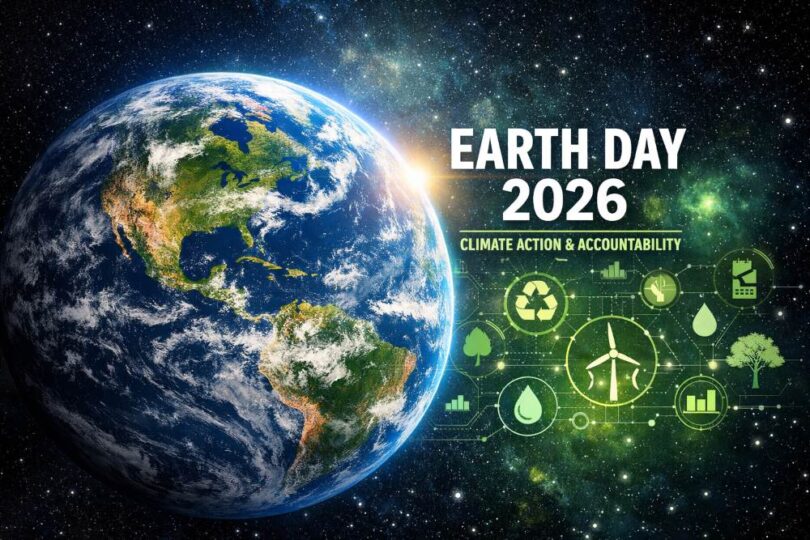
Earth Day 2026 marks a continued shift from environmental awareness campaigns towards measurable climate accountability, as governments, industries, and communities face growing pressure to deliver tangible progress on emissions, biodiversity, and resource use.
Since its inception in 1970, Earth Day has evolved into a global platform engaging more than one billion people annually. In recent years, however, the focus has moved beyond symbolic participation to emphasise verifiable outcomes aligned with international frameworks such as the Paris Agreement.
Earth Day 2026 highlights accountability in climate action
The central theme emerging around Earth Day 2026 is accountability. While net zero targets have been widely adopted across both public and private sectors, scrutiny is intensifying over how these commitments translate into real-world impact.
Organisations such as the Earth Day Network are increasingly calling for transparency in emissions reporting, alongside accelerated deployment of clean technologies and nature-based solutions.
Key areas of focus include:
- Decarbonisation of energy systems through renewables and electrification
- Protection and restoration of ecosystems, particularly forests and oceans
- Scaling circular economy models in manufacturing and waste management
- Improving water resilience amid rising climate variability
The role of technology and innovation
Technological advancement continues to play a central role in shaping outcomes linked to Earth Day 2026. Developments in carbon capture, digital monitoring systems, and AI-driven environmental analytics are enabling more precise tracking of emissions and resource use.
At the same time, innovation alone is not sufficient. Experts increasingly highlight the need for policy alignment, infrastructure investment, and behavioural change to ensure technologies deliver systemic impact.
Climate data platforms and satellite monitoring systems are also improving the verification of environmental claims, reducing the risk of greenwashing and strengthening regulatory oversight.
Bridging the gap between commitments and delivery
Despite progress, a persistent gap remains between climate pledges and implementation. According to the Intergovernmental Panel on Climate Change (IPCC), current trajectories still fall short of limiting global warming to 1.5°C.
This challenge is particularly evident in sectors such as heavy industry, agriculture, and transport, where decarbonisation pathways are more complex and capital intensive.
Earth Day increasingly serves as a checkpoint rather than a celebration, providing an opportunity to assess progress and highlight areas requiring accelerated action.
Why Earth Day still matters
While the tone of Earth Day 2026 reflects urgency, its global reach remains a critical driver of engagement. Public awareness continues to influence policy direction, corporate strategy, and investment decisions.
The day also plays a role in connecting local initiatives with global frameworks, helping to translate international climate goals into community-level action.
For Climate Global News readers, the significance lies not only in awareness but in tracking how commitments evolve into measurable outcomes across energy, water, manufacturing, and environmental systems.
Explore more coverage in our Earth & Nature section.