


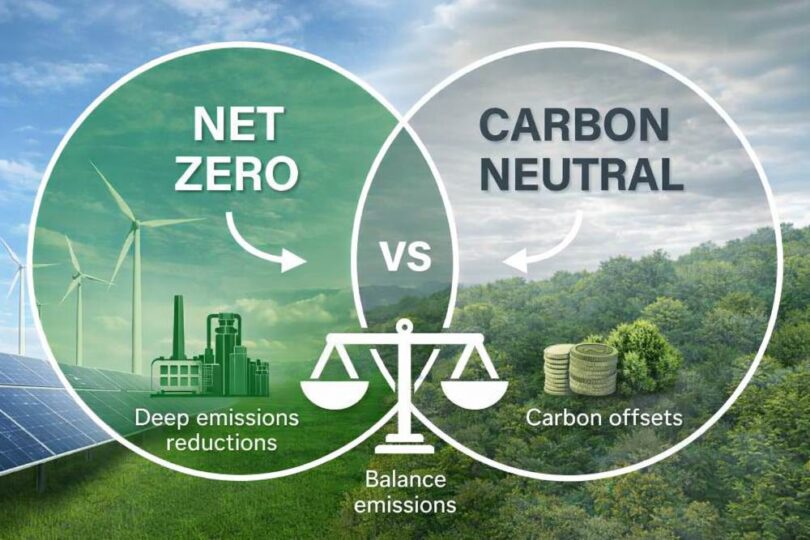
Net zero vs carbon neutral is a distinction that is increasingly important as governments, businesses and institutions set climate targets and make public sustainability claims. While the two terms are often used interchangeably, they represent different approaches to managing greenhouse gas emissions and carry different implications for credibility, accountability and long-term climate impact.
Understanding the difference between net zero and carbon neutral is essential for interpreting climate commitments, assessing environmental performance and avoiding confusion around emissions reduction claims.
What Is Net Zero?
Net zero refers to achieving a balance between greenhouse gas emissions produced and those removed from the atmosphere, resulting in no overall increase in emissions. Net zero strategies prioritise deep and sustained emissions reductions across operations, value chains and energy systems.
Any remaining emissions are balanced through carbon removal, such as restoring forests, improving soil carbon storage or deploying technologies that capture and store carbon dioxide.
International climate science bodies, including the Intergovernmental Panel on Climate Change, have identified net zero emissions as essential to stabilising global temperatures and limiting the worst impacts of climate change.
What Does Carbon Neutral Mean?
Carbon neutral typically refers to balancing carbon dioxide emissions associated with a specific activity, product or organisation by purchasing carbon credits or offsets. These offsets fund emissions reduction or removal projects elsewhere, such as renewable energy or reforestation initiatives.
Carbon neutral claims often focus on a narrower scope of emissions and may not require long-term structural changes to energy use or business models.
While carbon neutrality can support climate action, the credibility of such claims depends heavily on the quality, verification and permanence of the offsets used.
Net Zero vs Carbon Neutral: Key Differences
The difference between net zero vs carbon neutral lies primarily in scope, ambition and reliance on offsets.
- Scope: Net zero typically covers all greenhouse gases and full value chains, while carbon neutral often focuses only on carbon dioxide and limited activities.
- Emissions reduction: Net zero prioritises reducing emissions as close to zero as possible, whereas carbon neutrality may rely more heavily on offsets.
- Timeframe: Net zero is aligned with long-term climate science pathways, while carbon neutral claims can be made annually.
- Credibility: Net zero commitments are increasingly subject to regulatory and investor scrutiny.
Why the Difference Matters
The distinction between net zero and carbon neutral matters because misleading or unclear claims can undermine trust and slow genuine emissions reductions.
Regulators, investors and standards bodies are increasingly scrutinising climate claims to ensure they reflect real-world emissions reductions rather than accounting exercises. The United Nations Net Zero Coalition has emphasised that net zero commitments must be backed by credible action plans and near-term reductions.
For organisations, choosing between net zero and carbon neutral approaches affects strategy, investment decisions and long-term resilience.
Offsets, Accountability and Risk
Carbon offsets can play a limited role in both net zero and carbon neutral strategies, but overreliance on offsets carries risk.
Concerns include inconsistent standards, double counting and uncertainty over whether emissions reductions are permanent. As a result, climate policy and financial regulators are increasingly calling for greater transparency and stronger governance around offset use.
Net zero frameworks generally restrict the role of offsets, placing greater emphasis on direct emissions reductions.
Which Approach Is Gaining Momentum?
Net zero is rapidly becoming the dominant framework for climate commitments, particularly among governments and large organisations.
Energy system pathways published by the International Energy Agency indicate that achieving net zero emissions requires fundamental changes to energy production, transport and industrial processes.
While carbon neutral claims may continue to be used for specific products or events, net zero is increasingly viewed as the benchmark for credible climate leadership.
Further Reading
Additional coverage on climate targets, emissions reduction and sustainability strategy is available in our Energy section.