

Greener transport and monitoring
From October 2025, Acer will introduce its first electric-truck shipments in the Netherlands, reducing local air pollution and transport-related emissions. The company has also partnered with logistics providers Kuehne+Nagel and DSV to expand the use of Hydrotreated Vegetable Oil (HVO) and other certified biofuels, replacing traditional fossil fuels across its European supply routes.
A dedicated internal monitoring tool now tracks CO₂ emissions per shipment, enabling targeted interventions to improve environmental performance across Acer’s global transport network. The system supports transparency and data-driven decisions on logistics efficiency.
Scaling sustainable logistics
Acer’s supply chain handles over 5,000 TEUs of sea freight, 3,000 full truckloads and more than a dozen equivalent air cargo flights each year, connecting production hubs in Asia to destinations across Europe, the Middle East and Africa. Sea freight remains the company’s preferred mode of transport due to its lower environmental footprint compared with air freight.
“Choosing sea transport is a deliberate sustainability decision,” said Riccardo Bernasconi, EMEA Senior Director of Supply Chain at Acer. “It reduces emissions and limits the impact of crises such as the Suez Canal blockage, which can significantly affect both costs and environmental performance.”
In 2022, shipment consolidation alone reduced 779 truck journeys, cutting 593 tonnes of CO₂ emissions. The switch to Sustainable Maritime Fuel (SMF) has delivered up to 85% lower emissions compared with conventional shipping fuel.
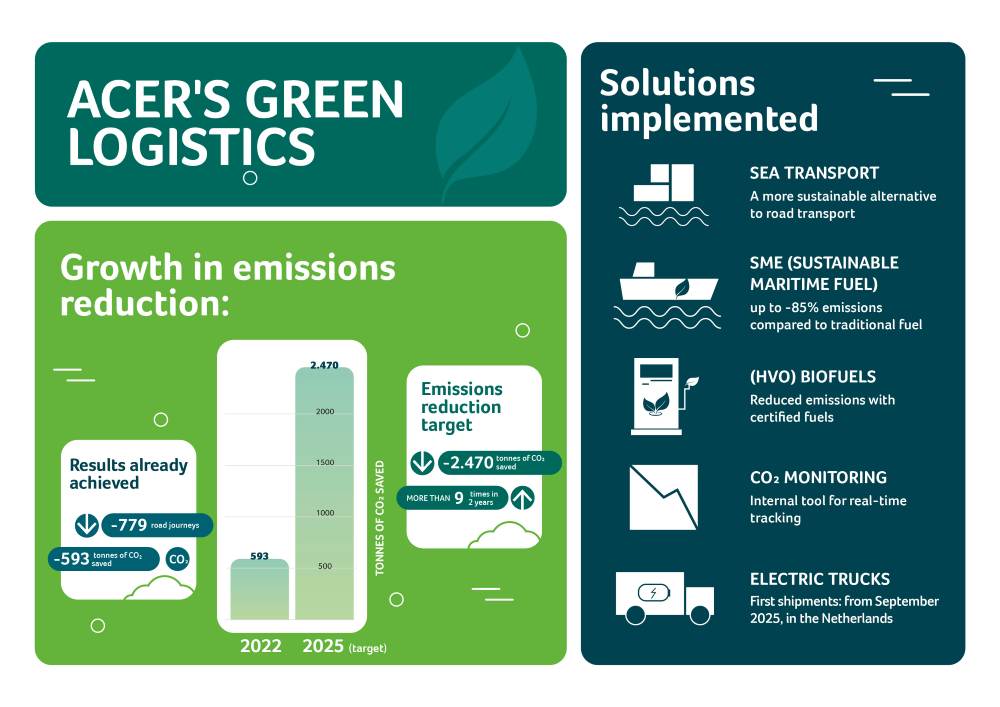
Acer’s Green Logistics strategy outlines how the company plans to cut 2,470 tonnes of CO₂ from its supply chain by 2025 using electric trucks, certified biofuels and sustainable maritime transport.
Reinvestment in sustainability
Acer’s progress is supported by an internal reinvestment mechanism that channels company budgets and contractual penalties into sustainability projects. The system funds ongoing environmental initiatives, ensuring continuity and accountability.
Ave Stella Maris Crotti, Sustainability Manager at Kuehne+Nagel, said: “Collaboration and transparency are essential to turning ESG commitments into real-world action. Together with partners like Acer, we are reshaping supply chains to be profitable, sustainable and future-proof.”
Innovation and circularity
Beyond logistics, Acer is working to increase efficiency in spare-parts management in preparation for the EU’s upcoming Right to Repair directive. The company’s motherboard repair programme enables faulty components to be refurbished and reused, reducing waste and supporting a circular economy approach.
Trivikram Jayacham, EMEA HR Senior Director at Acer, added: “Sustainability is part of our culture. From large-scale decarbonisation to employee-driven initiatives like e-bike schemes and EV charging stations, every project contributes to lowering our environmental impact.”
The company’s partnerships with Kuehne+Nagel, DSV and the University of Applied Sciences and Arts of Southern Switzerland (SUPSI) continue to strengthen its capacity for research, innovation and sustainable transport development across the EMEA region.