


A new scientific review has warned that the rapid expansion of offshore wind farms could have complex impacts on marine ecosystems, and has urged stronger international coordination on biodiversity safeguards. The study, published in Nature Reviews Biodiversity, was led by Plymouth Marine Laboratory with partners including the University of Portsmouth and the UK’s Department for Environment, Food and Rural Affairs (Defra).
Offshore wind is a key technology for achieving net-zero goals, with global capacity projected to nearly triple from 117 GW in 2023 to more than 320 GW by 2030. Expansion is taking place across 158 countries, with Europe, Asia and the Americas holding the greatest potential for growth. However, the review warns that without consistent monitoring and governance, offshore wind projects could undermine global biodiversity commitments, including those under the UN Ocean Decade and the Convention on Biological Diversity.
Mixed impacts on biodiversity
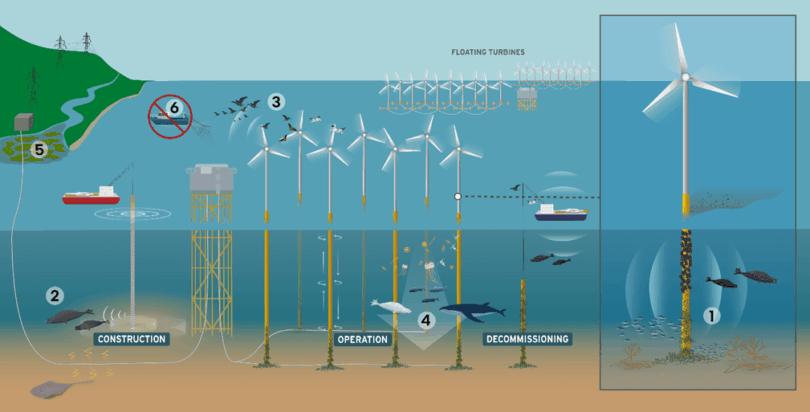
The review found that offshore wind farms (OWFs) create both risks and opportunities for marine life. Turbine structures can act as artificial reefs, providing habitat for some species, but construction and operation can also cause disturbance, noise, and displacement of fisheries. Effects vary across species, regions and stages of the wind farm lifecycle, making it difficult to establish global trends.
Six key ecological impacts were identified, including changes to species abundance and diversity, altered behaviour, mortality risks, food web disruptions, benthic habitat change, and indirect impacts such as fisheries displacement.
Evidence gaps and new tools
While fixed-bottom wind farms have been studied extensively in Europe and North America, evidence remains scarce in other regions. Research on floating wind farms and decommissioning impacts is also limited, despite their growing role in future projects.
The authors recommend greater use of emerging technologies such as environmental DNA (eDNA), digital twin simulations, AI-powered ecosystem models and autonomous survey systems. They also call for international data-sharing platforms and regional ecosystem monitoring programmes to help align offshore renewable energy with biodiversity goals.
Balancing climate and biodiversity
Dr Stephen Watson, lead author and Senior Ecosystem Services Scientist at Plymouth Marine Laboratory, said: “Offshore wind is vital for achieving net-zero goals but it must not come at the cost of ocean health. Our review shows that its impacts on biodiversity are mixed; turbines can create new habitats but also disturb species. Closing evidence gaps is critical to ensuring offshore wind is both climate-positive and biodiversity-positive.”
Quick Reference Links