

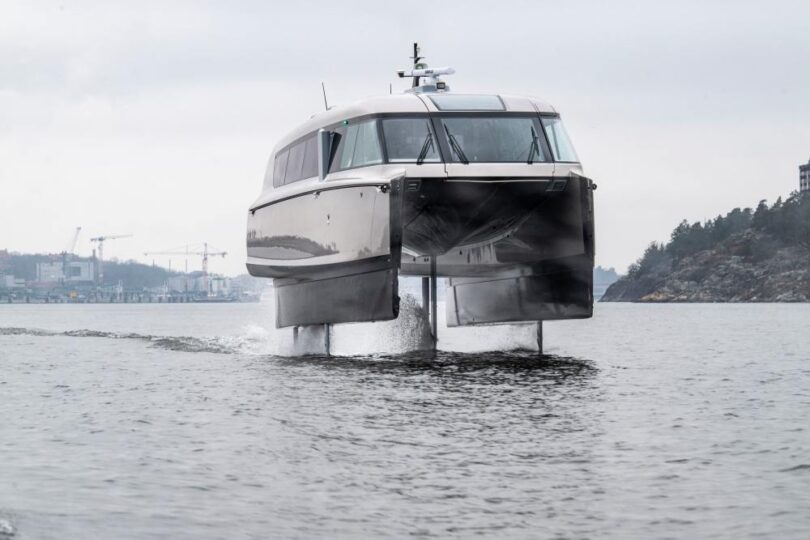
Electric hydrofoil ferry funding is gaining momentum as Swedish company Candela secures €30 million to expand production of its electric vessels, highlighting growing interest in alternatives to fossil-fuelled maritime transport.
The investment round, which includes backing from the International Finance Corporation (IFC), part of the World Bank Group, will support the development of a second manufacturing facility and scale production of Candela’s P-12 electric hydrofoil ferry.
The funding comes at a time of rising global fuel costs, with increasing pressure on transport operators to reduce both emissions and operating expenses.
Electric hydrofoil ferry funding signals shift in maritime transport
The electric hydrofoil ferry funding reflects a broader shift in the maritime sector, where operators are seeking more efficient and lower-emission alternatives to conventional diesel vessels.
Candela’s P-12 ferry uses a computer-controlled hydrofoil system that lifts the vessel above the water, significantly reducing drag. According to the company, this design can cut energy consumption by up to 80% compared to traditional ships, while also eliminating wake.
Real-world deployments across cities including Stockholm, Gothenburg, Oslo and Trondheim have demonstrated reduced operating costs and shorter journey times compared to conventional ferries.
Gustav Hasselskog, founder and CEO of Candela, said: “From a physics perspective, ships have been essentially the same for hundreds of years. We’re redefining waterborne transport by effectively creating a new category of vessel.”
Why maritime transport is difficult to decarbonise
Maritime transport is widely considered one of the most challenging sectors to decarbonise due to the energy demands of moving large vessels through water.
Traditional ships rely on fossil fuels because of their high energy density and the lack of scalable alternatives. However, innovations such as hydrofoil technology reduce resistance and energy requirements, making electrification more viable for certain routes, particularly in coastal and urban transport.
As fuel prices increase and environmental regulations tighten, technologies that improve efficiency and reduce reliance on fossil fuels are gaining attention from both investors and policymakers.
For more on clean transport developments, see our coverage of transport innovation.
Global expansion plans supported by new investment
The latest funding round brings Candela’s total capital raised to €129 million and will support expansion into new international markets.
More than 65 vessels are currently on order, with planned deployments in regions including India, the Maldives, Saudi Arabia and Thailand. In Mumbai, a fleet of P-12 ferries is expected to significantly reduce travel times between the airport and city centre.
The company is also developing a second manufacturing facility in Poland to support increased production capacity and improve access to emerging markets.
Farid Fezoua, Director for Equity, Funds and Venture Capital at IFC, said: “By supporting Candela’s expansion, we aim to accelerate the adoption of innovative transportation solutions in emerging markets and enable more efficient water-based mobility.”
The investment comes despite a broader slowdown in climate technology funding, suggesting continued confidence in solutions that combine emissions reduction with cost efficiency.