


Public support for hydrogen fuel cell heavy-duty vehicles in South Korea could play a decisive role in cutting transport emissions, according to new academic research that suggests households value carbon reductions far above current market prices.
The study, published in the journal Transport Policy, examines public willingness to pay for expanding hydrogen fuel cell heavy-duty trucks as part of South Korea’s long-term freight decarbonisation strategy. Researchers found that households are prepared to financially support the transition, making the policy socially profitable despite high upfront infrastructure costs.
Public support for hydrogen fuel cell heavy-duty vehicles in South Korea
South Korea’s government plans to replace around 30,000 diesel-powered trucks with hydrogen fuel cell heavy-duty vehicles by 2040. If delivered, the transition could reduce transport sector emissions by up to 8.74 million tonnes of carbon dioxide.
To assess public acceptance, researchers conducted in-depth interviews with 1,000 households across South Korea in 2024, using a contingent valuation method to estimate willingness to pay through annual income tax contributions.
The findings show an average annual willingness to pay of KRW 3,121 per household between 2024 and 2033. When aggregated nationally and discounted at a social rate of 4.5%, this equates to a present value of KRW 572.4 billion.
Carbon value exceeds market prices
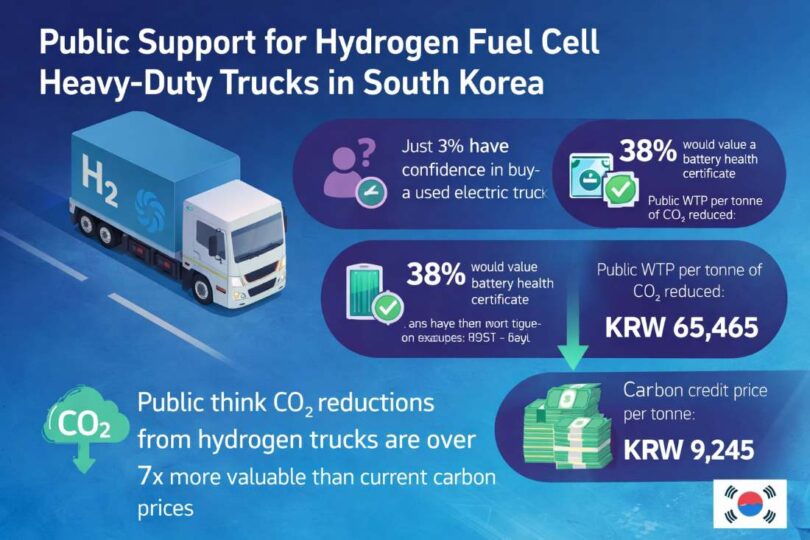
Crucially, the study estimates a public willingness to pay of KRW 65,465 per tonne of carbon dioxide reduced — more than seven times higher than South Korea’s prevailing carbon credit price of KRW 9,245 per tonne.
This suggests households place a significantly higher value on emissions reductions from heavy-duty hydrogen trucks than current market mechanisms reflect.
Professor Seung-Hoon Yoo, one of the study’s authors from Seoul National University of Science and Technology, said the findings demonstrate strong public backing for hydrogen freight transport:
“This is the first study to quantitatively assess public acceptance of expanding hydrogen fuel cell heavy-duty trucks, rather than passenger cars or buses.”
Infrastructure challenges remain
Despite strong public support, the research highlights structural barriers that could slow deployment. Hydrogen refuelling infrastructure in South Korea is often concentrated at bus depots, limiting access for freight operators.
The authors recommend expanding refuelling stations along key logistics corridors and aligning tax incentives for hydrogen trucks with those already available for hydrogen buses.
Implications beyond South Korea
The findings offer broader lessons for countries seeking to decarbonise freight transport. While hydrogen trucks face higher capital costs than conventional vehicles, public acceptance and social value may justify targeted government support.
As heavy-duty vehicles account for a disproportionate share of transport emissions, policies that reflect public willingness to pay could accelerate cleaner logistics systems and deliver significant air quality and climate benefits.
The full study, titled Public acceptance towards expanding hydrogen fuel cell heavy-duty trucks in South Korea: A monetary assessment based on willingness to pay, is published in Transport Policy.